The Role of Automation in Reducing Laundry Labor Costs
In today’s competitive market, the operational efficiency of a laundry facility is no longer a secondary consideration; it is a fundamental pillar of business viability. As labor costs continue to escalate and the availability of skilled personnel remains volatile, industrial and commercial laundry operators must look toward technological solutions to safeguard their margins. In the world of high-volume laundry: spanning hotels, hospitals, and specialized commercial plants: automation has emerged as the most crucial strategy for mitigating the financial burden of human labor.
For facility managers and business owners, the transition to automated systems is not merely about replacing manual effort with mechanical action. It is about a strategic overhaul of the entire workflow. By integrating intelligent machinery, real-time data analytics, and precision-engineered logistics, organizations can achieve a level of throughput that was previously unattainable. This transition represents a shift from a labor-intensive model to a capital-efficient one, where technology serves as the primary driver of productivity.
The Automation Imperative: Addressing the Labor Crisis
The commercial laundry sector has historically been one of the most labor-heavy industries within the facility management spectrum. Traditionally, the process: from sorting and loading to folding and finishing: required significant human intervention at every touchpoint. However, in 2026, the economic landscape has changed. Rising minimum wages, high turnover rates, and the physical demands of the job have made it increasingly difficult to maintain a reliable and cost-effective workforce.
Automation addresses these challenges by neutralizing the variables associated with manual labor. Machines do not suffer from fatigue, they do not require breaks, and they maintain a consistent level of quality across a 24-hour cycle. When a facility adopts industrial-grade laundry equipment with advanced automation features, it essentially de-risks its operations against the rising costs of the labor market.
Programmable Controls and Smart Washing Technology
The first stage of labor reduction begins at the wash cycle itself. Modern industrial washing machines have evolved far beyond simple mechanical timers. Today’s equipment features highly sophisticated, programmable logic controllers (PLCs) that allow for the customization of every variable in the wash process.

By utilizing digital control interfaces, operators can standardize wash recipes for specific linen types, soil levels, and fabric requirements. This precision is essential because it eliminates the need for constant supervision. Once a cycle is programmed, the machine handles the water temperature, chemical injection, and mechanical action with absolute consistency.
Furthermore, IoT-enabled machines provide real-time feedback to facility managers. Through centralized dashboards, a single supervisor can monitor the status of an entire floor of machines, receiving alerts for cycle completions or maintenance needs. This "one-to-many" management ratio is a vital component of modern labor reduction, allowing a smaller team to oversee a significantly larger volume of equipment.
Precision Drying and Moisture Sensing
Drying is often a bottleneck in laundry operations, primarily due to the inefficiencies of over-drying. When staff manually check loads or use generic timers, linens are frequently subjected to excessive heat for longer than necessary. This not only wastes energy but also accelerates fabric wear and occupies valuable labor hours in unnecessary monitoring.

Advanced industrial stack dryers and heavy-duty tumble dryers now incorporate moisture-sensing technology. These sensors detect the exact point at which the linen reaches the desired dryness level and automatically terminate the cycle. This "auto-stop" feature is important for two reasons: it reduces the time an operator must spend checking loads, and it ensures that the equipment is immediately available for the next batch, maximizing throughput per labor hour.
Chemical Optimization: The Automated Advantage
One of the most overlooked aspects of labor reduction is the automation of chemical delivery. Manual dosing is not only prone to error and waste but also poses safety risks to staff and requires significant time for training and supervision.
Wash IQ specializes in chemical cost optimization, helping businesses transition to automated chemical injection systems. These systems precisely dispense detergents, softeners, and sanitizers directly into the wash cycle based on the specific load requirements.

By automating this process, facilities eliminate the manual handling of heavy containers and the risk of improper mixing, which can lead to re-washes and damaged linens. Re-washing is a significant hidden labor cost; every load that must be processed twice represents a 100% increase in the labor required for that specific batch. Precision automation ensures that every load is cleaned correctly the first time, protecting the bottom line.
Finishing and Folding: The Final Frontier of Automation
The finishing stage: ironing and folding: is historically the most labor-intensive part of the laundry process. In large-scale operations like hotels and hospitals, the manual folding of thousands of towels or sheets per day is a massive drain on resources.

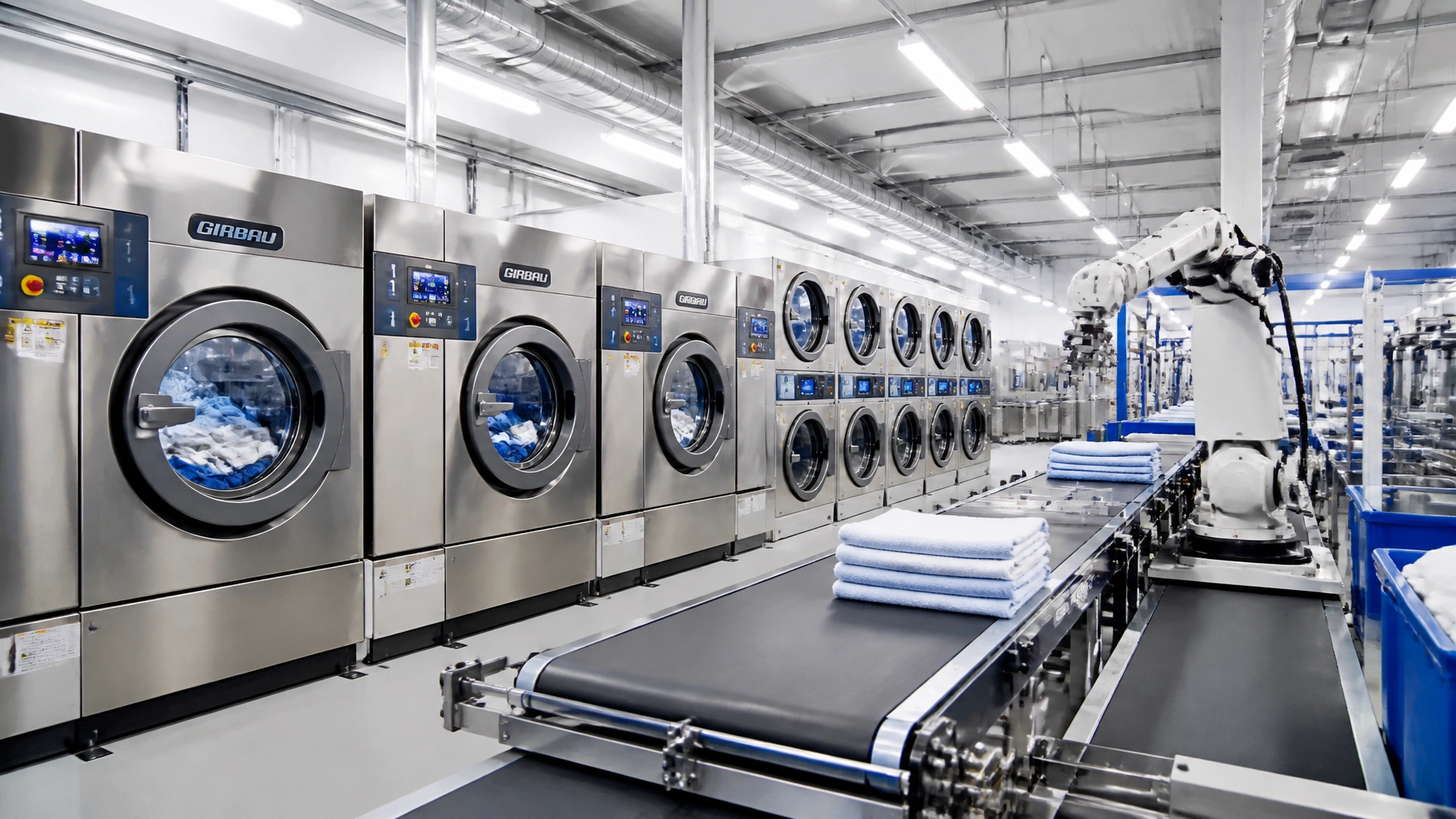
The implementation of automated flatwork ironers and folding machines is a game-changer for high-volume facilities. These machines can process linens at a speed and consistency that manual labor cannot match. For instance, an automated folder can take a towel directly from the dryer and produce a perfectly uniform fold in seconds, ready for the shelf. When integrated with feeding systems, these machines allow a single operator to do the work that previously required a team of four or five.
Strategic Facility Design and Logistics
Automation is most effective when it is supported by a logical facility layout. Wash IQ’s design services focus on optimizing the flow of linen from the dirty intake to the clean output. This includes the strategic placement of machines to minimize the physical distance staff must travel, as well as the potential integration of automated conveyor or rail systems.

In 2026, many leading facilities are adopting Automated Guided Vehicles (AGVs) and overhead rail systems to transport heavy loads between stations. By automating the internal logistics of the plant, managers can eliminate the need for staff to push heavy carts across the floor, reducing both labor hours and the risk of workplace injuries. This holistic approach to automation ensures that every element of the facility is working toward a common goal: maximum output with minimum human intervention.
The Role of Efficiency Reports in Labor Management
To truly master labor costs, data is essential. Wash IQ provides efficiency reports that analyze every facet of a laundry operation. These reports identify where bottlenecks occur and where labor is being underutilized. By correlating machine data with labor schedules, facility managers can make informed decisions about when to run shifts and how to deploy their team most effectively.
This data-driven approach allows for "predictive labor management." Instead of reacting to a backlog of laundry, managers can use the throughput data from their automated systems to schedule the exact amount of labor needed to handle the incoming volume. This level of precision is the hallmark of a world-class laundry operation.
Conclusion: Securing the Future of Your Facility
The transition toward automation is not a luxury; it is a necessity for any business that relies on industrial-grade laundry solutions. Whether you are managing a boutique hotel or a large-scale hospital laundry, the ability to reduce labor costs through technology will determine your long-term success.
At Wash IQ, we understand that every facility has unique challenges. With over 50 years of industry expertise, we provide the equipment, the chemicals, and the strategic design services needed to transform your laundry into a high-efficiency powerhouse. By investing in automation today, you are not just buying machines; you are securing the future of your operation against the rising costs of tomorrow.