
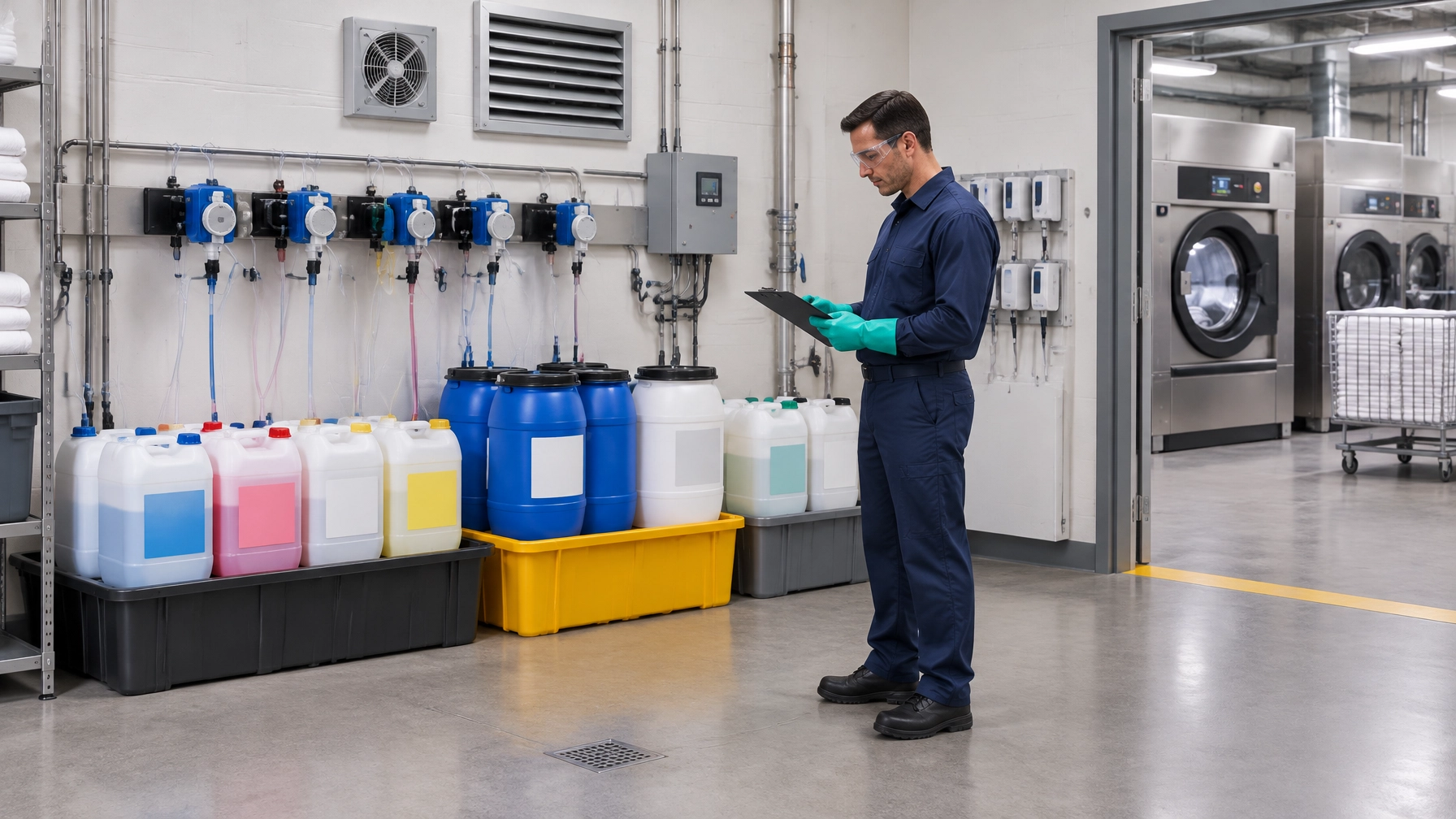
Chemical Safety and Handling in a Commercial Laundry: A Facility Manager’s Guide
In today’s competitive market, reliable laundry operations depend on more than selecting the right industrial laundry equipment. Chemical handling affects the people who work in the facility, the linens they process, the life of commercial washers and dryers, and the organization’s exposure to safety and compliance risks. It is a management responsibility, not simply a housekeeping task.
Use this guide to orient a new laundry supervisor. Site procedures, product labels, safety data sheets (SDSs), equipment instructions, and applicable regulations must always take precedence.
1. Chemical handling is a management responsibility
A poorly controlled chemical program can create risks across the operation. Workers may be exposed to splashes, vapors, or mislabeled products. Incorrect chemistry or dosing can damage textiles, leave residue, or contribute to equipment wear and corrosion. Gaps in training, labeling, or SDS access can also create regulatory exposure.
Managers should establish clear responsibilities for safe storage, dispensing, training, inspections, and incident reporting. Under OSHA’s Hazard Communication Standard, employers have duties that include communicating chemical hazards and ensuring workers can access relevant safety information. Requirements may also vary by state and locality.
Caution: Do not treat a chemical room as safe merely because containers are closed or staff have used the products before. Conditions, products, and hazards can change.
2. Understand the chemistry in the room
A supervisor should know what each product does, where it is used in the wash process, and what it must not contact. Product labels and SDSs, not container color or staff memory, are the authority.
Common laundry chemical categories
- Detergents help loosen and suspend soils so they can be removed in the wash. Their performance depends on the product, water conditions, temperature, and soil load.
- Alkalis and builders support cleaning by creating suitable wash conditions and, in the case of some builders, managing minerals in the water. These categories may be combined in a product or provided separately.
- Bleaches help remove stains or whiten textiles through an oxidizing process. Their chemistry and effective conditions vary; bleach must be used only in its designated process stage.
- Souring agents are typically used later in the process to neutralize residual alkalinity and help bring linen toward the desired final condition.
- Softeners are generally added in a final rinse to affect textile feel. Adding them too early can interfere with cleaning or leave unwanted deposits.
Why order and temperature matter
Wash chemistry balance means matching the right products and process conditions to the linen, soil, and water. In business terms, each part of the formula must do its job at the right time without interfering with another part. Water temperature affects how products dissolve and react, but the appropriate temperature depends on the formula, product directions, and textile requirements.
There is no universal dosing sequence for every facility. Follow the validated wash formula and the product instructions. Do not mix concentrated products or improvise a sequence. Keep incompatible products, especially acids and chlorine-containing bleach, separate.
3. Store and segregate products correctly
Keep chemicals in a designated, orderly area with suitable ventilation, temperature conditions, and access controls, as specified by product instructions and site requirements. Keep exits, eyewash stations, and safety showers clear.

Use secondary containment compatible with the products stored there. Separate incompatible categories using appropriate distance, dedicated containment, barriers, or designated storage areas. Never place incompatible products in a shared tray where a leak could let them mix. Keep containers closed, upright, and in good condition; retain original labels and do not use food or drink containers for chemicals.
Maintain current SDSs for the products on site. Keep them physically accessible where employees can reach them during a shift, and provide digital access only as a reliable complement, not a barrier to urgent information. The SDS should be available at the point of use, and workers should know how to find its hazard, PPE, first-aid, and spill-response sections.
Caution: A product without a legible label, or a container whose contents are uncertain, should not be used. Follow the facility’s procedure for isolating and identifying it.
4. Control dispensing and dosing
Automated dosing systems can reduce routine contact with concentrates and help deliver a repeatable formula. They still require inspection and verification. Manual measurement, where approved, requires designated measuring tools, careful handling, and compliance with the product directions and site procedure. Never estimate a dose or use an unmarked vessel.
Verify the system on a defined schedule
Set a documented calibration and inspection schedule with the chemical provider or qualified service personnel. The schedule should account for the dosing equipment, the facility’s operating conditions, and any changes to products or wash formulas. Verify calibration after relevant service or configuration changes, and record the check and any corrective action.
A drifted pump may deliver too much or too little. A clogged line, air leak, kink, worn tubing, or loss of prime can interrupt delivery or make it inconsistent. Check for leaks, alarms, unusual changes in product consumption, and discrepancies between programmed and observed operation.

Overdosing is not a safety margin. It can increase chemical exposure, leave residue, harm linen, and contribute to equipment problems, while using product unnecessarily. Underdosing can also compromise cleaning. Keep the approved formula in control; do not compensate for poor results by casually increasing a dose.
5. Use PPE and follow safe work practices
Select PPE according to the product label, SDS, task, and facility risk assessment. Depending on the task, this may include chemical-resistant gloves, splash goggles, a face shield, an apron, or other protective clothing. Store, inspect, and replace PPE according to site procedure. Ensure workers know how to use it before handling chemicals.
Spill and exposure response sequence
- Stop work and alert others. Keep people away from the affected area and maintain access to exits and emergency equipment.
- Identify the product only from a safe position. Consult its label and SDS. Do not approach an unknown release or one producing fumes.
- Escalate when needed. Evacuate and follow the facility emergency plan for a large, unknown, uncontrolled, or potentially incompatible spill. Call emergency responders as directed by that plan.
- Limit cleanup to trained, authorized personnel. They should use the specified PPE and spill materials, and follow the SDS and site procedure. Do not improvise a neutralization method.
- Report and document the event. Follow facility procedures for waste disposal, incident reporting, and review.
For eye or skin contact, use the site’s eyewash or safety shower immediately and follow the SDS and emergency procedure. Notify a supervisor and obtain medical assistance as directed by the facility’s response plan. This is an operational first-response instruction, not a substitute for medical care.
Caution: Never mix chemicals during cleanup. If a spill involves incompatible products or there is a risk of hazardous fumes, leave the area and escalate.
6. Train, document, and verify
A shift-level chemical safety briefing should cover the products in use, their hazards, required PPE, safe dispensing practices, storage locations, and the location of SDSs and emergency equipment. Review spill and exposure steps, including who to notify and when to stop work. Brief employees when new products, tasks, or hazards are introduced.
Record the date and shift, topics covered, trainer, attendees, questions or issues raised, and any follow-up actions. Keep records according to your organization’s requirements. Build verification into routine inspections: check labels and SDS access, PPE and spill-kit readiness, storage segregation, visible leaks, dosing-system condition, and completion of calibration checks.

7. Recognize signs of a handling problem
Chemical or process issues may show up as:
- Linen graying or yellowing
- Premature fabric failure
- Residue complaints or unusual feel
- Corrosion on machine components
- Employee reports of skin, eye, or respiratory irritation
These symptoms can have multiple causes, including water conditions, textile type, equipment, or wash-process settings. Treat them as signals to investigate, not proof of one specific chemical fault. Document what changed, protect affected employees, and review the formula, product instructions, dosing system, water conditions, and equipment with qualified support.
8. Bring in a professional review when needed
Chemical optimization is a safety and operational review, not simply a cost-cutting exercise. A qualified assessment can examine dosing accuracy, chemistry selection, water conditions, wash programs, storage, and how the chemical system interacts with the equipment. The goal is a controlled process that protects workers and linen while supporting consistent performance and avoiding unnecessary product use.
Wash IQ provides chemical selection and cost optimization alongside equipment support and efficiency reports. Its team has more than 50 years of industry experience and offers service and repair for any brand. For facilities planning equipment purchases, Wash IQ also offers a three-year parts and labor warranty on its products. Whether you operate a hotel, hospital, assisted living center, banquet facility, commercial laundry, or need OPL laundry solutions, align chemical procedures with the equipment and the work being performed.
Safety and efficiency are the same project: clear procedures, correct chemistry, dependable dosing, trained employees, and routine verification. Make those expectations part of every shift, and revisit them whenever products, equipment, or operating conditions change.