How to Reduce Water Consumption in an OPL Laundry
In today’s competitive market, controlling operating costs is essential for hotels, hospitals, banquet halls, assisted living centers, and commercial laundries. Water is one of the most under-managed expenses in an OPL laundry because its use is easy to overlook: it flows through machines and pipes out of sight, while the bill arrives later. Sewer charges may also be tied to the volume of water coming in. And when that water is heated, it carries an additional energy cost.
Reducing consumption does not have to start with new equipment. Start by measuring what the laundry uses, then work through a practical audit in order. This sequence helps distinguish avoidable losses from necessary process water, and protects cleaning quality while you pursue efficiency.
1. Establish a baseline before making changes
Read the utility bill in context
Gather several recent water and sewer bills. Check the billing periods, units, service charges, and how sewer use is calculated. A bill may cover more or fewer operating days than the previous one, or include consumption from other parts of the building. Compare equivalent periods where possible and note relevant changes in occupancy, laundry volume, or operating schedules.
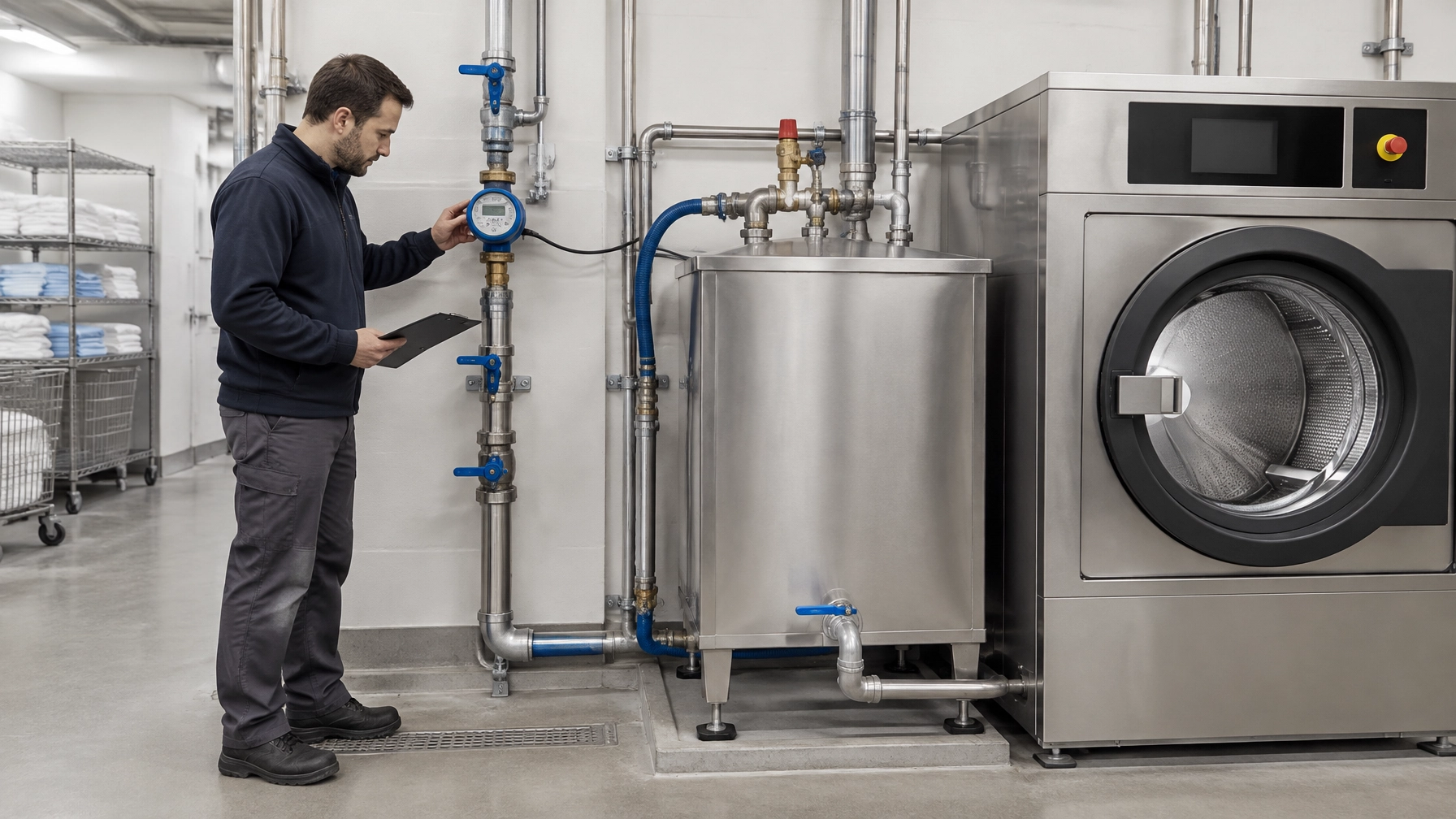
The building’s total bill can reveal a trend, but it cannot show whether the laundry caused it. If the laundry is a major water user and its consumption is unclear, a submeter can help separate laundry use from other building demand. Consider the cost and access required, and ask what decisions the readings would inform. If the laundry’s usage is already measurable another way, a dedicated meter may not be the first step.
Normalize consumption against production
Track water alongside laundry output so that changes in volume do not mislead you. A consistent measure might be water per pound of linen processed or water per piece, depending on how your operation records production. Use the same method and denominator each month. For mixed operations, record categories separately where practical; a load of towels and a load of lightly soiled guest linen do not necessarily follow the same process.
The U.S. Environmental Protection Agency’s WaterSense at Work laundry equipment guidance provides additional context on laundry water use and equipment. A useful baseline for your own building is the one you can measure consistently, not a target borrowed without accounting for your linen mix, hygiene requirements, and equipment.
2. Find water losses that are not the machine’s fault
Walk the water path
Inspect hoses, fittings, valves, and visible pipework for drips, damp areas, or signs of corrosion. A small leak can continue between loads and may be missed during a busy shift. Check washers when idle as well as when running: a fill valve that does not close completely can allow water to keep entering after the machine should have stopped filling.
Also look at supply or storage tanks. Overflowing tanks, faulty controls, or settings that are out of adjustment can waste water outside the wash cycle itself. Ask staff whether they hear water running when no machine is filling, or notice unusual discharge.
Confirm rinse timing and line drainage
Compare how long rinse water actually runs with the time the wash formula calls for. Rinse steps that continue beyond their intended duration may point to a control issue, a setting, or a process habit. Check whether water remains in lines after a cycle or is routinely flushed away before it can be used. Record observations rather than adjusting settings immediately; first establish what is happening and whether the process is working as designed.
3. Audit the wash formulas
Match water levels and steps to the work
Water levels, cycle steps, and soil removal need to work together. Loads with different textiles, soil, and service requirements may need different formulas. An oversized fill or extra rinse may have become routine even when the load does not require it. But less water is not automatically better: insufficient water can interfere with cleaning, chemical distribution, or consistent results.
Review formulas with the people responsible for laundry quality and chemical dosing. Include hygiene and sanitation requirements, especially for healthcare and assisted living linens. A formula must meet those requirements before it is considered an efficiency improvement.
Test changes carefully
If a formula appears to use more water than necessary, test a leaner version in a controlled way. Change one variable at a time, such as a water level or a rinse step, so you can identify what caused any change in results. Keep the load type and evaluation method consistent. Check cleanliness, residual chemistry where relevant, appearance, odor, finish, and rewash frequency against your established standards.
A simple change log helps staff use the approved formula and makes results traceable. Chemical optimization can support water reduction, but dosing and rinse decisions should be reviewed as a connected process, not adjusted in isolation.

4. Check the equipment’s contribution
Verify fill accuracy and level sensing
A washer that fills beyond its intended level uses more water than the formula requires. Check whether observed fill levels match programmed settings and whether level sensing responds consistently. Inaccurate sensing, faulty valves, or control problems can undermine even a well-designed formula. Document irregularities and have a qualified technician assess them rather than compensating by rewriting the process.
Wash IQ’s routine commercial laundry maintenance guidance explains why prompt attention to equipment issues can help prevent small faults from becoming larger operational problems.
Consider extraction as part of water and energy use
Extraction performance affects how much water remains in linen after washing. When textiles leave the washer wetter than expected, the dryer must remove more moisture, shifting cost from the washer to energy and extending drying demand. That is why a water-saving change in the wash cycle should be evaluated alongside linen dryness and dryer performance.
High-extraction capability can reduce residual moisture before drying, but the right solution depends on the fabric, process, equipment condition, and operational requirements. Commercial washers and dryers should be assessed as a system: saving water in the washer while leaving linen wet may simply move the expense downstream.

5. Evaluate recovery and reuse where it makes sense
Understand the basic options
Rinse water reuse means capturing water from a suitable rinse and using it in a later stage where its cleanliness is appropriate, for example, an earlier wash step. Heat recovery captures some heat from warm wastewater and transfers it to incoming water. In plain terms, these approaches retain some of the water or heat already paid for instead of sending it all directly to the drain.
Check the building constraints first
Reuse and heat recovery are not automatic fits for every existing laundry. Consider available floor space, tank placement, plumbing routes, drainage, maintenance access, and how staff would operate the system. Water quality and linen requirements also matter: recovered water must be appropriate for its intended step, and reuse must not compromise hygiene or finishing.
If the building cannot support the needed storage or piping, a technically sound concept may be impractical. For new or substantially renovated facilities, planning these needs early can be easier than retrofitting them later. Wash IQ’s installation and maintenance services overview describes its design support for commercial laundry facilities.

6. Make the review part of routine operations
Assign an owner and keep a simple record
Give a specific person responsibility for a monthly water review. Record water use, laundry output, normalized consumption, billing-period dates, and any operational changes that may explain a shift. Review the trend rather than reacting to one bill in isolation.
After changing a formula, repairing a fault, or adjusting equipment, recheck the same measures. Confirm that the change reduced normalized consumption without creating quality issues, increased rewashing, or pushing more drying work onto the dryer. If results worsen, investigate and revise the action.
A consistent review turns a one-time audit into an operating control. It also gives facility managers a clearer basis for deciding whether a repair, process adjustment, or larger investment is warranted.
When to bring in outside help
If the baseline points to unexplained use, inconsistent fills, excess rewashing, or competing priorities, a professional efficiency report can help benchmark the operation, identify the highest-return actions, and sequence them against the available budget. Expert repair can correct fill and level faults that routine observation cannot resolve.
For facilities still in the planning stage, laundry design services can address equipment layout, plumbing, and space needs before they become costly retrofit constraints. Wash IQ provides industrial laundry equipment, design, repair, and operational support, including OPL laundry solutions for single locations and multi-site operations.
Action summary: Establish a normalized baseline, inspect for leaks and uncontrolled flow, review formulas one change at a time, verify washer and extraction performance, assess reuse against building constraints, and assign someone to review results monthly. Measure first; then act on what the data shows.