
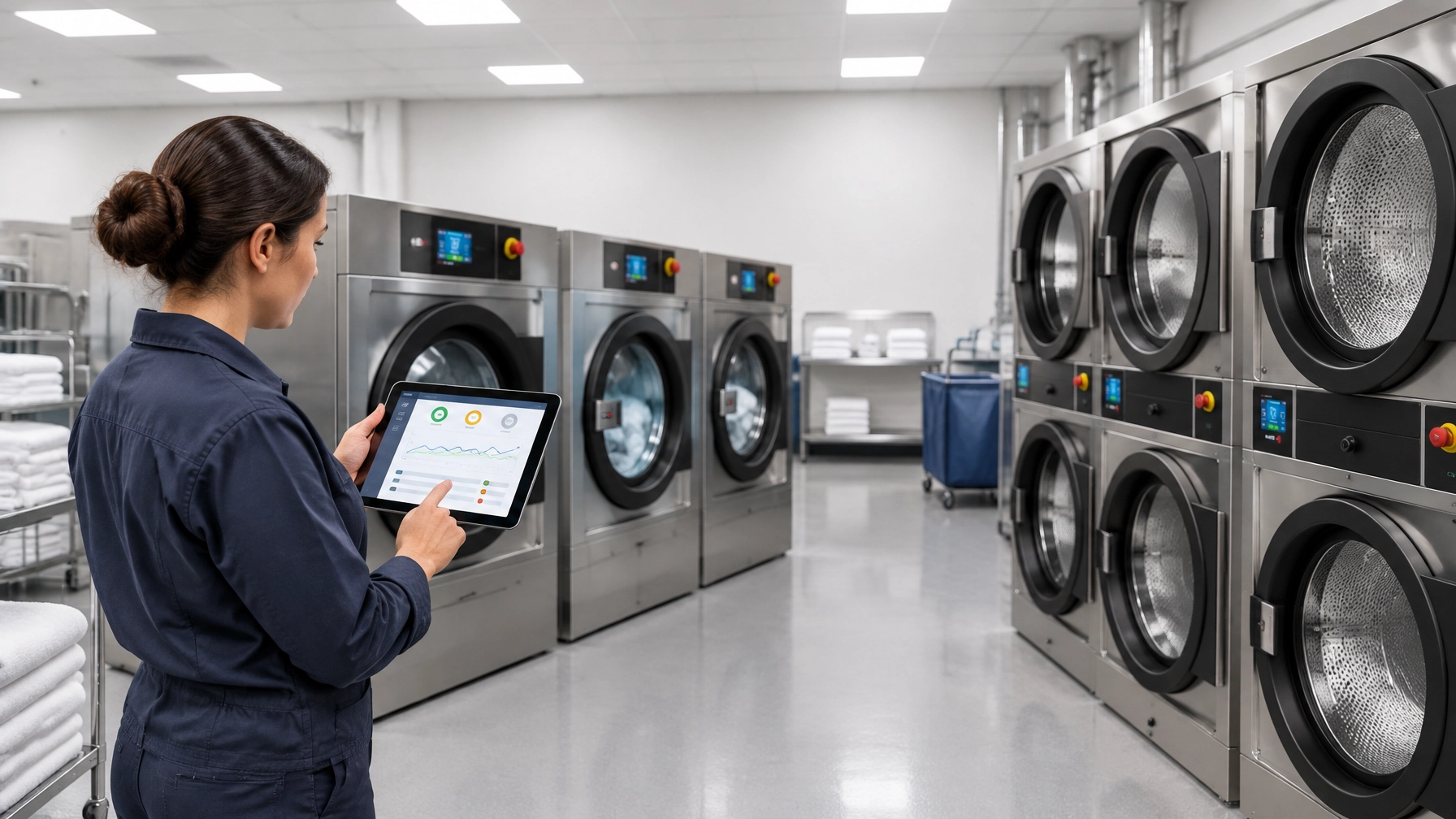
Real-Time Monitoring in Commercial Laundry: What It Actually Delivers
In today’s competitive market, laundry managers are often promised more visibility, fewer breakdowns and better efficiency from real-time monitoring. Those outcomes are possible, but a dashboard alone does not deliver them. The practical question is what information reaches the floor, who acts on it and whether the information changes a decision.
For hotels, hospitals, banquet halls, assisted living centers and commercial laundries, monitoring is best understood as an operational tool, not a substitute for experienced staff, sound processes or a maintenance plan. Its value depends on the quality of the data and the discipline around using it.
What real-time monitoring actually is
A monitoring system collects information from sensors and machine controllers, then presents it through a dashboard, report or alerting layer. Depending on the equipment and setup, it may report machine status, cycle counts, cycle progress, temperatures, error conditions, chemical consumption and utility draw.
The specific data available varies. Some machines can report operating information directly; others may require added sensors or connections. A dashboard may show that a cycle stopped or that a fault occurred, but it cannot necessarily identify the underlying cause. Utility or chemical readings may also depend on separate metering or dispensing-system data.

Monitoring is therefore not a single, standard capability. Before comparing systems, a facility should confirm which signals can be collected from its industrial laundry equipment, how often they update and what conditions trigger an alert.
What it delivers
Earlier awareness of faults
A fault alert can tell staff that a machine has stopped, failed to complete a cycle or reported an error. This does not prevent every breakdown, and it does not guarantee that a developing mechanical problem will be detected. It can, however, shorten the time between an event and someone becoming aware of it, especially when the laundry room is not continuously supervised.
Better information for service dispatch
A service request that includes the machine, time, fault message and recent operating history is more useful than “the washer is down.” That information can help a service provider prepare for the visit, ask targeted questions and consider likely parts or diagnostic steps. Monitoring does not diagnose every problem remotely, but it can give an expert repair team a more informed starting point.
Evidence about throughput shortfalls
When output falls behind, managers need to know whether the constraint is a machine outage, idle time, cycle duration or a process issue. Machine-state and cycle records can help distinguish among these possibilities.
That evidence matters: a washer showing frequent idle periods may point to scheduling or staffing issues, while repeated interrupted cycles may justify a maintenance review. Monitoring does not automatically establish why an operator or machine is behind, but it can replace assumptions with a more objective record.
A shared view across locations
For a multi-site portfolio, a consolidated dashboard can make it easier to see which locations have active faults or unusual operating patterns. This is useful for prioritizing attention across sites. It does not eliminate the need for local context: a hospital, hotel and commercial plant may have different linen demands, staffing models and operating hours.
Records for capital planning
Cycle counts, utilization patterns, recurring faults and downtime records can support decisions about equipment replacement, capacity or service needs. These records are more useful than anecdotal impressions, particularly when reviewed over time and alongside repair history, utility costs and production requirements.

What it does not deliver
It does not repair equipment
An alert is not a repair. Someone must assess the issue, determine its urgency and arrange the appropriate response. Monitoring can improve the information available to a technician, but reliable equipment still depends on qualified service and access to parts.
It does not fix a poor load profile or workflow
A dashboard may show cycles and machine availability; it does not correct overloading, inconsistent sorting, poor scheduling or an inefficient path through the room. If a process is producing rewash, waiting time or bottlenecks, data may help identify where to investigate, but process changes require management and staff follow-through.
It does not replace preventive maintenance
Routine inspections, cleaning, calibration and service remain important. A machine can operate without generating a clear alert while still needing attention. A monitoring platform should complement an established maintenance program, not become the reason to defer scheduled checks.
Wash IQ’s guidance on routine commercial laundry maintenance explains why regular service matters even when equipment appears to be running normally.
It does not create accountability by itself
If no one is responsible for reviewing notifications, deciding what warrants escalation and confirming that follow-up occurred, alerts can accumulate without changing operations. A dashboard that nobody owns can produce a false sense of control: information is visible, but the problem remains.
The operating discipline behind the dashboard
Monitoring pays when it is built into the working routine. Before rollout, assign a role, not just a department, to each step.
Define the alert path
Specify who checks alerts during each operating window, including nights or weekends if the laundry runs then. Decide which events require an immediate response, which can wait for the next shift and which should be recorded for review. Establish who contacts the service provider and who confirms that the issue has been resolved.
Review performance on a schedule
A daily check can focus on active faults and machines unavailable for production. A recurring operational review can examine patterns in cycle completion, idle time, interruptions and usage. The schedule should fit the facility’s workload; reviewing every notification in real time is not automatically useful if staff cannot act on it.
Feed findings into maintenance and efficiency work
Repeated errors, abnormal usage or increasing downtime should become documented work, not just dashboard observations. Use monitoring records to inform the maintenance schedule, service requests and efficiency reviews. For multi-site operators, agree on common definitions and reporting practices so that comparisons are meaningful.
A practical adoption sequence
A single-site OPL laundry can start narrowly. First confirm what its existing machines can report and whether wireless coverage is reliable in the laundry room. Then enable alerts for critical faults and machine unavailability, assign an owner and test the escalation process. Once staff are acting consistently, add cycle and utilization reviews. Expand into utility, chemical or broader performance reporting only when the data is available and someone will use it to make decisions.
A multi-site portfolio should begin with a small, representative rollout rather than assuming every site and machine will connect in the same way. Establish a common set of critical alerts, confirm data access and local response responsibilities, then compare whether records are consistent enough for portfolio reporting. Add more detailed performance measures in stages, with a named owner for follow-up at both site and central levels.

How to evaluate a monitoring offering
Ask practical questions before committing:
- Data ownership: Who controls the records, and what happens to access if the service ends?
- Export and portability: Can information be exported in a usable format for internal analysis or reporting?
- Service fit: Can alerts and records support your existing service relationship, or do they require a new process?
- Alert fatigue: Can thresholds and notifications be configured so staff receive actionable messages rather than a constant stream?
- Wireless coverage: Has connectivity been tested in the actual laundry room, where metal equipment, moisture and room layout may affect signal?
- Lifecycle cost: What are the costs of setup, connections, subscriptions, maintenance and future changes? Evaluate the total over the period you expect to use the system.
Also clarify how readings are collected and what a “normal” reading means. A number without context, or a faulty sensor, can prompt unnecessary action or hide a real issue.
Monitoring works best alongside expertise
Real-time records can help service technicians arrive with better information and help facility managers identify where to investigate. They do not replace hands-on diagnosis. Wash IQ provides repair and maintenance support for commercial laundry equipment, including service across brands.
Efficiency reports add another layer of interpretation. A dashboard may reveal cycle counts or utility patterns, but a professional review can connect those records to operating practices, equipment condition, load profile, chemical dosing and facility layout. That context can help determine whether the right response is equipment service, workflow adjustment, chemical optimization or a capital decision. Monitoring is an input to that work, not a replacement for it.
A decision framework for facility managers
Before adopting a system, answer four questions:
- What decision should the data improve? Name the specific issue, such as slow fault response, uncertain utilization or limited multi-site visibility.
- Can the system collect relevant, reliable data from your equipment? Confirm coverage, connectivity and export options on site.
- Who will act, and when? Define alert ownership, escalation thresholds and review frequency.
- How will you judge value? Choose operational measures that matter to your facility, such as response time, downtime records or the usefulness of data in maintenance and capital planning.
If those answers are clear, monitoring can provide useful visibility for commercial washers and dryers and support better decisions. If not, begin by strengthening maintenance routines and reporting practices. The technology is most valuable when it gives people better evidence, and those people have the responsibility and expertise to act on it.