How Often Should You Really Service Your Industrial Laundry Equipment?
In today’s competitive market, the reliability of your infrastructure is not merely a convenience; it is a fundamental pillar of operational success. For businesses such as hotels, hospitals, and commercial laundry facilities, industrial-grade equipment represents a significant capital investment. When these machines fail, the consequences extend far beyond a simple repair bill: they ripple through your entire operation, manifesting as lost productivity, compromised hygiene standards, and diminished customer trust.
The question of how often you should service your industrial laundry equipment is, therefore, a question of risk management. While every facility has unique demands, a structured, high-frequency maintenance program is essential to safeguard your assets and ensure the long-term viability of your laundry operations. At Wash IQ, we advocate for a proactive approach that prioritizes prevention over correction.
The Imperative of Preventive Maintenance
Maintaining industrial laundry equipment is not a task to be performed only when a breakdown occurs. In the world of high-volume laundry, "run-to-failure" is a strategy that leads to catastrophic operational costs. According to industry data, facilities that implement systematic maintenance programs report up to 40% fewer emergency repair calls.
The benefits of a structured servicing schedule are multi-faceted:
- Operational Longevity: Regular servicing can extend the lifespan of your commercial machines by three to five years, maximizing your Return on Investment (ROI).
- Energy Efficiency: Calibrated and clean equipment can reduce water and energy consumption by up to 20%, significantly lowering your utility expenses.
- Safety and Compliance: Regular inspections of exhaust ducts and safety interlocks are vital for fire prevention and meeting stringent workplace safety standards.
The Servicing Timeline: A Strategic Breakdown
To maintain peak performance, your maintenance strategy must be divided into specific intervals. Each level of service addresses different technical needs, from basic hygiene to deep mechanical overhauls.
1. Daily Maintenance: The Front Line of Defense
Daily checks are the most crucial layer of safety and damage prevention. These tasks should be integrated into your staff’s standard operating procedures.
- Lint Filter Clearance: In dry units, lint buildup is a primary fire hazard and a major cause of airflow restriction. Filters must be cleaned after every cycle.
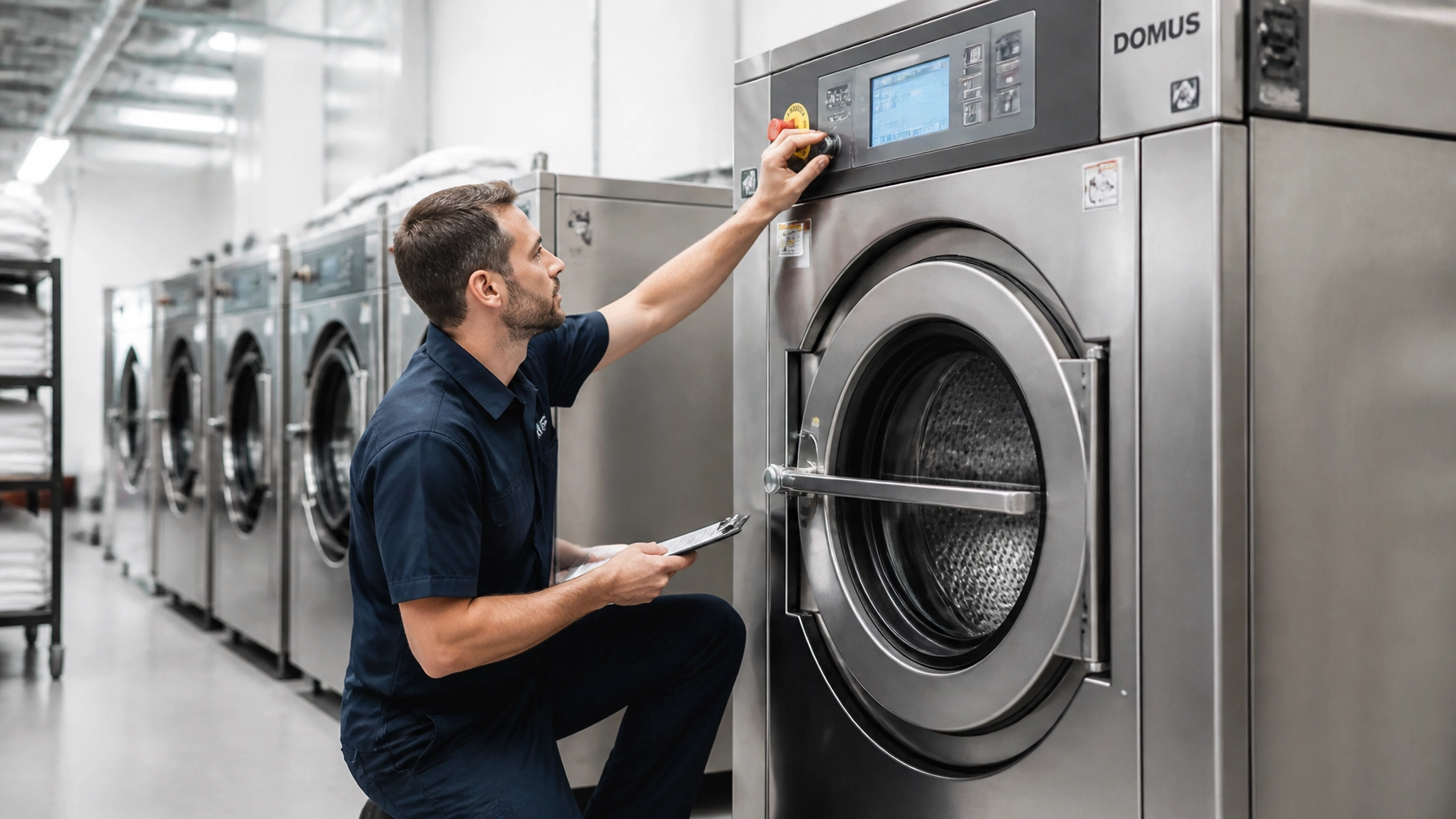
- Visual and Auditory Inspections: Staff should be trained to identify unusual vibrations, leaks, or error codes on digital interfaces.
- Safety Interlocks: Confirm that emergency stop buttons and door locks are functioning perfectly before starting production.

2. Weekly and Monthly Servicing: Performance Optimization
Weekly and monthly tasks focus on the cleanliness and mechanical integrity of the machines, preventing the gradual degradation of performance.
- Chemical Buildup Removal: Industrial detergents and softeners can leave corrosive residues. Weekly cleaning of dispensers and drums is vital to protect the stainless steel components.
- Belt and Bearing Inspection: On a monthly basis, a deeper look at drive belts and moving parts is necessary. Early detection of wear prevents the sudden snapping of a belt mid-cycle, which can lead to significant downtime.
- Performance Tracking: Utilize efficiency reports to review error logs and cycle times. This data-driven approach allows you to identify developing failures before they manifest as a total breakdown.

3. Quarterly and Semi-Annual Service: Technical Integrity
Every three to six months, your equipment requires a thorough technical inspection by a qualified professional. This level of service goes beyond the capabilities of most on-site janitorial staff.
- Mechanical Calibration: Technicians should check and adjust drive systems, motor mounts, and suspension components.
- Electrical Systems: Inspection of wiring and control boards is essential to prevent electrical shorts and ensure the precision of water level and temperature sensors.
- Exhaust Duct Deep Cleaning: Professional duct cleaning is a requirement for commercial operations to maintain fire safety compliance.
4. Annual Professional Overhaul
Once a year, a comprehensive diagnostic should be performed. This annual service serves as a "physical" for your facility, providing a clear picture of the health of your entire equipment lineup. At this stage, worn parts are replaced proactively, and systems are recalibrated to manufacturer specifications.

Industry-Specific Requirements
The frequency of service is also influenced by the nature of your industry. A high-turnover boutique hotel has different needs than a 500-bed hospital.
- Healthcare Facilities: In hospitals, hygiene is non-negotiable. Maintenance schedules must strictly adhere to infection-control protocols, with frequent sanitization of equipment to prevent cross-contamination.
- Hospitality and Banquet Halls: These facilities experience extreme peak volumes. To prepare for high-capacity events, a "pre-peak" inspection is recommended to ensure every machine is operating at 100% capacity.
The Wash IQ Advantage: Beyond Simple Repairs
At Wash IQ, we understand that industrial laundry is a complex ecosystem. With over 50 years of industry expertise, we provide more than just repair services; we offer a complete, one-stop solution for your laundry facility.
Our commitment to your success includes:
- Expert Repair and Maintenance: Our technicians are experienced with all major brands of laundry equipment, ensuring that your repairs are performed correctly the first time.
- Chemical Cost Optimization: We help businesses reduce chemical expenses while actually improving the quality of their laundry output.
- Custom Facility Design: We assist in planning and optimizing your layout for maximum throughput and efficiency.
- Industry-Leading Warranty: We stand behind our products with a 3-year parts and labor warranty, providing you with peace of mind.

Conclusion: Investing in Reliability
In the world of industrial laundry, downtime is the enemy of profitability. By adhering to a rigorous servicing schedule: ranging from daily checks to annual professional overhauls: you are not just maintaining machines; you are protecting your business’s bottom line.
If your facility is currently operating on a reactive "fix-it-when-it-breaks" model, it is time to transition to a more sophisticated, proactive strategy. Contact Wash IQ today to learn how our comprehensive maintenance services and efficiency reports can help you achieve operational excellence.