What Is a ‘Dark Factory’ and Should Your Laundry Facility Go Lights Out?
In today’s competitive market, the industrial laundry sector is undergoing a profound transformation driven by the pursuit of operational excellence and unprecedented efficiency. As labor shortages persist and utility costs fluctuate, facility managers and business owners are increasingly looking toward advanced automation to secure their bottom line. One of the most provocative concepts emerging from the broader manufacturing world is the "dark factory": a facility capable of operating with little to no human intervention, quite literally "lights out."
In the world of industrial laundry, the transition to a dark factory model represents the pinnacle of modernization. It is not merely about replacing a single machine but about reimagining the entire workflow through a lens of total integration. For hospitality, healthcare, and commercial laundry providers, understanding the feasibility of this model is essential to maintaining a leadership position in the industry.
Defining the 'Dark Factory' in Laundry Operations
A dark factory, or "lights-out" manufacturing site, is a facility where the production process is fully automated. The term "dark" refers to the fact that machines do not require visual light to function; therefore, the facility can operate in near-total darkness, saving on energy while maintaining 24/7 productivity.
In an industrial laundry context, this concept involves the end-to-end automation of sorting, washing, drying, finishing, and internal logistics. While a truly 100% human-free laundry facility is still a rarity, the industry is rapidly moving toward "dark shifts" or "dark cells": specific periods or sections of the plant that function entirely through programmed logic and robotic hardware.
The Technological Foundations
To achieve this level of autonomy, several technological pillars must be in place:
- Industrial IoT (Internet of Things): Sensors that monitor machine health, water temperatures, and chemical concentrations in real-time.
- RFID Tracking: The ability to identify every piece of linen, its age, its owner, and its specific processing requirements without manual scanning.
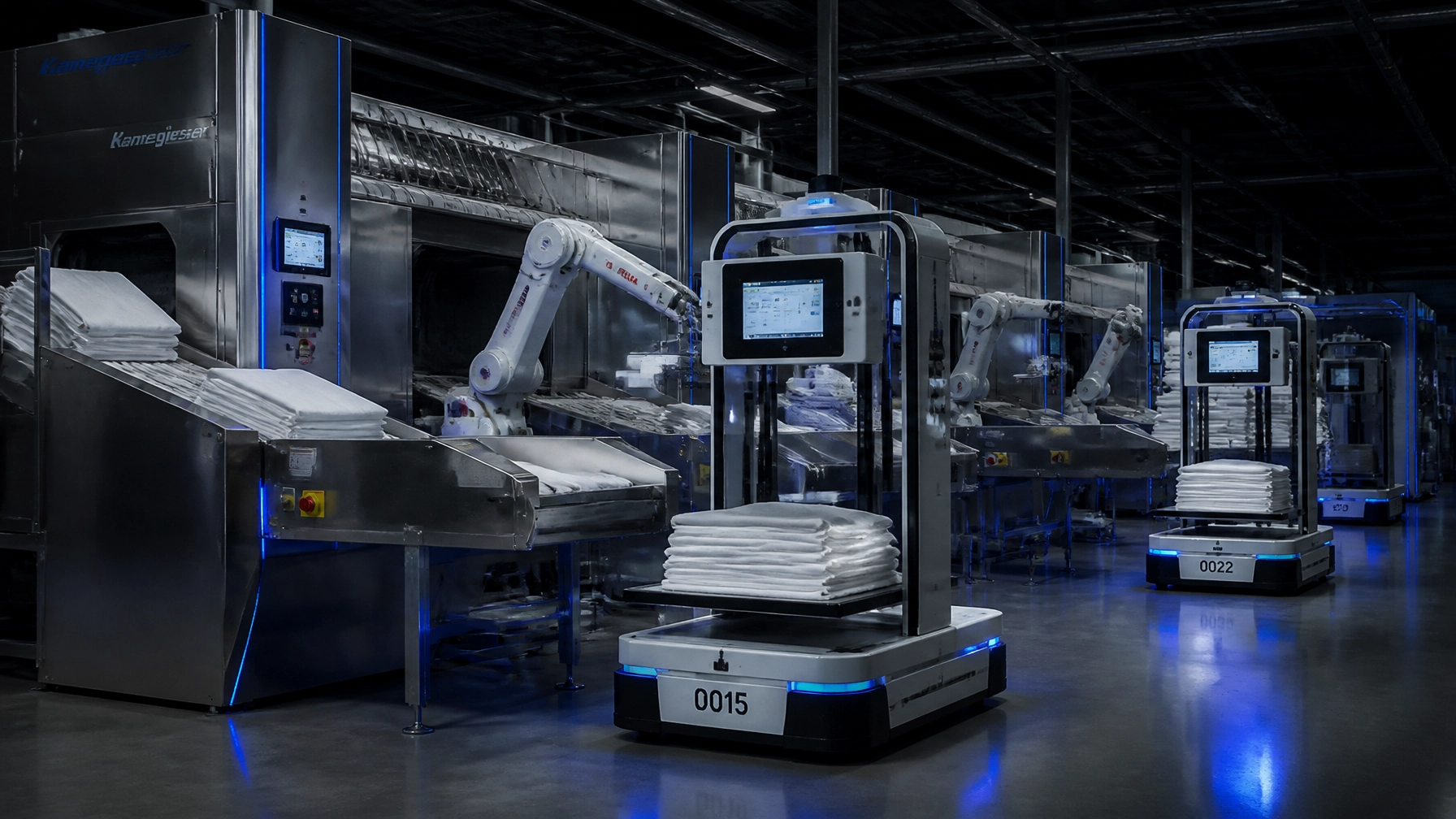
- Automated Guided Vehicles (AGVs): Robotic carts that transport heavy loads of soiled or clean linen between stations.
- AI-Driven Orchestration: Software that predicts bottlenecks and re-routes tasks to ensure maximum throughput.
The Core Pillars of a "Lights Out" Laundry
To understand if a dark factory approach is viable, one must examine how automation handles the traditional stages of the laundry cycle.
1. Automated Sorting and Inbound Handling
The most labor-intensive part of any laundry operation is typically the sorting of soiled goods. In a dark factory, RFID-tagged bags are scanned upon arrival. Gravity-fed rails or automated conveyors then route these bags directly into the washing systems. Advanced vision systems are now beginning to assist in identifying foreign objects, which has historically been a major barrier to full automation.
2. High-Capacity Washing and Chemical Precision
The heart of the facility remains the washing equipment. In a highly automated environment, tunnel washers or high-capacity washer-extractors are integrated with centralized chemical dosing systems.

At Wash IQ, we emphasize that Chemical Cost Optimization is vital in this stage. An automated facility cannot afford the inconsistency of manual pouring or improper titration. Precision dosing ensures that every load is treated with the exact amount of detergent, destainer, and neutralizer required, preventing fabric damage and reducing waste.
3. Integrated Drying and Moisture Sensing
Once the wash cycle is complete, automated shuttles transfer the linen to industrial dryers. In a "lights out" scenario, these dryers utilize sophisticated moisture sensors to determine the exact moment a load is ready.

Manual checking of "dryness" is a thing of the past. These machines communicate with the facility's central management system, signaling the next available AGV to transport the dry goods to the finishing department. This seamless handoff is what allows the facility to operate unattended during overnight shifts.
4. Robotic Finishing and Packaging
The finishing stage: ironing, folding, and stacking: has traditionally required significant manual labor to "feed" the machines. However, modern high-speed feeders and folders now feature automatic alignment and rejection of torn or stained items.

For healthcare and high-end hospitality clients, the consistency provided by robotic finishing is a crucial advantage. It ensures a standard of quality that is difficult to maintain with a rotating manual staff, especially during high-volume periods.
The Business Case: ROI and Operational Impact
The move toward a dark factory is a strategic investment in long-term stability. While the initial capital expenditure for Industrial Laundry Equipment Sales and automation hardware is significant, the return on investment (ROI) is driven by three primary factors:
Labor Resilience
The industrial laundry industry is often plagued by high turnover and rising wage demands. Automation mitigates these risks by reducing the headcount required for repetitive, ergonomically taxing tasks. This allows your remaining staff to focus on high-value roles such as maintenance and quality oversight.
Energy and Chemical Efficiency
Automated systems are inherently more precise than human operators. By utilizing Efficiency Reports, facility managers can identify exactly where utilities are being over-consumed. Dark factories optimize water and heat recovery systems to a degree that manual plants cannot match, leading to substantial savings in monthly operating costs.
24/7 Throughput
A "lights out" facility does not need to pause for breaks, shift changes, or holidays. This constant flow increases the overall capacity of the plant without needing to expand the physical footprint of the building.
Should Your Facility Go "Lights Out"?
While the allure of a dark factory is strong, it is important to determine if it is the right move for your specific operation. Transitioning to full automation is a journey, not a single purchase.
- Volume Requirements: Full automation is most effective for facilities handling high volumes of standardized items, such as hotel linens or hospital sheets.
- Technical Readiness: Does your facility have the IT infrastructure to support IIoT and centralized control?
- Maintenance Capabilities: Automated machines require expert care. With over 50 years of experience, Wash IQ’s Repair and Maintenance Services are essential for ensuring that your sophisticated hardware stays online. A breakdown in a dark factory can halt the entire production line if not addressed by specialists.
How Wash IQ Supports Your Transition
Whether you are looking to automate a single production cell or design a brand-new facility from the ground up, professional guidance is essential.

We provide a complete line of industrial-grade equipment and the expertise needed to integrate it. Our Design Services team works with you to plan layouts that maximize throughput and accommodate future robotic additions. We don't just sell machines; we provide the operational blueprint for your facility's success.
Conclusion
The "dark factory" is no longer a futuristic concept: it is a practical response to the challenges of the modern industrial landscape. By embracing automation, industrial laundry facilities can achieve a level of reliability and efficiency that was previously impossible.
In the world of professional laundry, the choice to modernize is a choice to lead. Whether you are ready to go fully "lights out" or simply want to improve the efficiency of your current setup, the path forward starts with a commitment to technical excellence.
For more information on how to optimize your facility or to explore our full range of Industrial Laundry Equipment, contact the experts at Wash IQ today.