10 Reasons Your OPL Laundry Solutions Aren’t Working (And How to Fix It)
In today’s competitive market, operational efficiency is not merely an advantage; it is a fundamental requirement for survival and growth. For industries such as hospitality, healthcare, and high-volume commercial services, the performance of On-Premise Laundry (OPL) operations directly dictates bottom-line profitability and service quality. When OPL laundry solutions underperform, the repercussions extend beyond simple utility waste: they lead to accelerated linen degradation, labor inefficiencies, and compromised guest or patient satisfaction.
Identifying why your laundry operation is failing to meet performance benchmarks is the first step toward restoration. Below, we analyze ten critical reasons why OPL systems underperform and provide professional strategies to correct these issues.
1. Operating with Outdated Equipment
One of the most common reasons for a decline in laundry productivity is the continued use of legacy machinery. In the world of industrial laundry, technology evolves rapidly. Older commercial washers and dryers often lack the sophisticated G-force extraction capabilities and programmable logic controllers found in modern units like the HE-Series Washers.
The Fix: Transitioning to high-efficiency, industrial-grade equipment is essential. Modern machines significantly reduce water and energy consumption while increasing moisture extraction, which drastically shortens drying times. Upgrading to advanced commercial washers and dryers ensures your facility benefits from the latest engineering breakthroughs.

2. Inadequate Equipment Sizing and Capacity
A common mistake in facility design is a mismatch between the volume of linen processed and the capacity of the equipment. If your machines are consistently too small for your throughput requirements, your staff must run more cycles, leading to excessive labor costs and mechanical wear. Conversely, over-sized machines that are run half-empty waste vital resources.
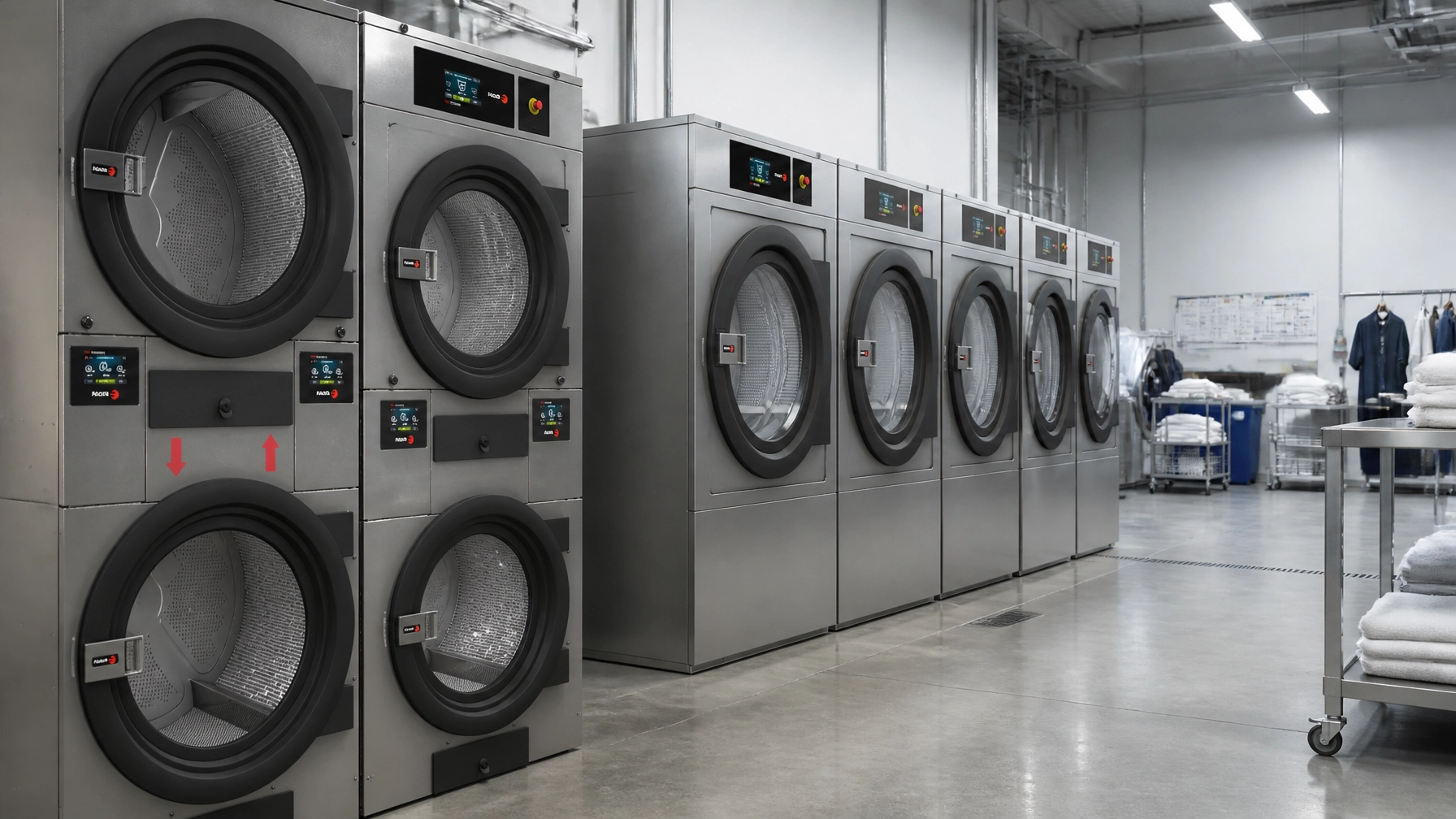
The Fix: A professional audit is necessary to balance your washer-to-dryer ratio. Utilizing high-capacity solutions such as industrial stack dryers can optimize floor space while maintaining the throughput necessary for peak demand periods.
3. Improper Chemical Ratios and Dosing
Achieving optimal wash results requires a precise chemical balance. If your OPL laundry solutions involve manual dosing or uncalibrated automatic dispensers, you risk "chemical burn" on linens or, conversely, inadequate cleaning that necessitates rewashes. Excess chemicals do not equate to cleaner laundry; they lead to greyed linens and skin irritation for the end-user.
The Fix: Implement comprehensive chemical cost optimization. By utilizing integrated dispensers that communicate directly with the machine’s controller, you ensure that every load receives the exact milliliter of detergent, bleach, and softener required, protecting both your textile investment and your budget.

4. Neglected Preventive Maintenance
In a high-demand environment, reactive maintenance: fixing things only after they break: is a recipe for operational disaster. Clogged lint screens, worn drive belts, and leaking valves can reduce the efficiency of your equipment by 20% or more before a total failure even occurs.
The Fix: Establish a rigorous preventive maintenance schedule. Professional repair and maintenance services with an emphasis on routine inspections can catch minor issues before they escalate into costly downtime. Regular cleaning of dryer ducts and washer inlet filters is crucial to maintaining peak performance.
5. Staff Training Gaps and Human Error
The most advanced commercial washers and dryers are only as effective as the individuals operating them. Common errors such as failing to check pockets for foreign objects, selecting the wrong cycle for specific fabric types, or ignoring error codes can lead to catastrophic mechanical failures.
The Fix: Comprehensive staff training is vital. Employees should be educated on the technical aspects of the equipment, including the importance of sorting linens by weight and fabric type. Clear signage and standardized operating procedures (SOPs) help maintain consistency across multiple shifts.
6. Suboptimal Facility Layout
Efficiency is often hindered by the physical environment. If your staff must transport wet, heavy laundry across a large room to reach the dryers, or if the "soiled" and "clean" paths cross, you are creating bottlenecks and hygiene risks. A poor layout increases labor time and reduces the overall cycle-per-hour count.
The Fix: Professional design services are essential when planning or renovating a laundry facility. A linear workflow: from sorting to washing, drying, and folding: minimizes wasted movement and ensures that your industrial laundry equipment is positioned for maximum productivity.
7. The Cost of Overloading and Underloading
Overloading a machine prevents proper mechanical action and chemical distribution, resulting in poor wash quality. Underloading, on the other hand, is an inefficient use of water, chemicals, and energy. Both practices put undue stress on the machine’s suspension and motor.
The Fix: Train staff to load machines to approximately 80% capacity. Utilizing machines with integrated weighing systems or clear "fill lines" can help operators hit the "sweet spot" for every cycle, ensuring the longevity of your industrial washers.
8. Ignoring Water Quality Issues
Hard water is a silent killer of OPL efficiency. Mineral buildup (scale) inside the machine’s heating elements and pipes forces the equipment to work harder, increasing energy costs and lead to premature part failure. Furthermore, minerals interfere with detergent performance, requiring more chemicals to achieve the same result.
The Fix: Conduct regular water quality tests. If high mineral content is detected, installing a water softening system is an important investment that will pay for itself through reduced chemical usage and extended equipment lifespan.
9. Inefficient Drying Cycles
The drying stage is typically the most energy-intensive part of the laundry process. Many facilities suffer from "over-drying," which not only wastes gas and electricity but also damages linen fibers, causing them to thin and tear prematurely.
The Fix: Invest in industrial-grade tumble dryers equipped with moisture-sensing technology. These sensors automatically stop the cycle when the desired level of dryness is reached, preventing linen damage and significantly reducing utility expenses.

10. Lack of Performance Monitoring and Reporting
You cannot manage what you do not measure. Many OPL operations continue to run without any data on cycle times, utility costs per pound, or rewash rates. Without this data, identifying the root cause of inefficiency becomes a matter of guesswork rather than professional analysis.
The Fix: Utilize efficiency reports and advanced monitoring software. Modern commercial laundry equipment can provide detailed logs of every cycle. Analyzing this data allows facility managers to identify patterns, such as a specific shift consistently over-using chemicals or a machine that is underperforming compared to its counterparts.
Achieving Operational Excellence with Wash IQ
Correcting an underperforming laundry operation requires more than just a quick fix; it demands a strategic partnership with industry experts. At Wash IQ, we leverage over 50 years of industry expertise to provide a "one-stop shop" for all your industrial laundry needs. From supplying state-of-the-art commercial washers and dryers to offering custom design services and technical support, we are committed to optimizing your facility for maximum efficiency.
By addressing these ten critical areas, you can transform your OPL department from a cost center into a streamlined, high-performance asset. Whether you operate a single hotel or a large-scale hospital facility, the path to excellence begins with the right equipment and the right expertise.