Why Water Reuse Systems Will Change the Way You Manage Commercial Laundry Utility Bills
In today’s competitive market, the pursuit of operational efficiency has moved from a strategic advantage to a fundamental necessity. For facilities operating high-capacity industrial laundry equipment: such as hotels, hospitals, and commercial processing plants: utility expenses often represent one of the largest controllable overhead costs. Traditional laundry operations have long relied on "once-through" water systems, where thousands of gallons of freshwater are consumed, heated, and immediately discharged into the sewer system. However, as utility rates rise and environmental regulations tighten, this standard model is becoming increasingly unsustainable.
The emergence of sophisticated water reuse systems represents a pivotal shift in facility management. By integrating advanced filtration and recycling technologies, businesses can transform their laundry operations from a resource-intensive burden into a streamlined, cost-effective asset. Understanding the technical and financial impact of these systems is crucial for any facility manager looking to secure long-term profitability and operational excellence.
The Inefficiency of the Standard Laundry Model
In the world of industrial-grade textile care, the standard approach to water management is surprisingly linear. A typical high-capacity washing cycle requires multiple fills of fresh municipal water. Each gallon must be treated with chemicals and, in many cases, heated to specific temperatures to ensure hygiene and soil removal. Once the cycle is complete, this treated, heated water: along with the energy used to heat it: is flushed directly into the sewer.
This "once-through" process creates two primary financial drains:
- Volume-Based Utility Costs: Facilities pay for every gallon of water entering the machine and, frequently, a corresponding fee for every gallon discharged as wastewater.
- Energy Waste: Large amounts of thermal energy are literally poured down the drain. Because fresh incoming water is typically cold, the facility must expend significant gas or electrical energy to reach the required wash temperatures for every single load.
For a mid-to-large-scale operation, these inefficiencies compound daily, leading to utility bills that can fluctuate wildly and impact the bottom line. At Wash IQ, we have spent over 50 years analyzing these patterns to help businesses identify where their capital is being unnecessarily washed away.

Technical Evolution: How Water Reuse Systems Operate
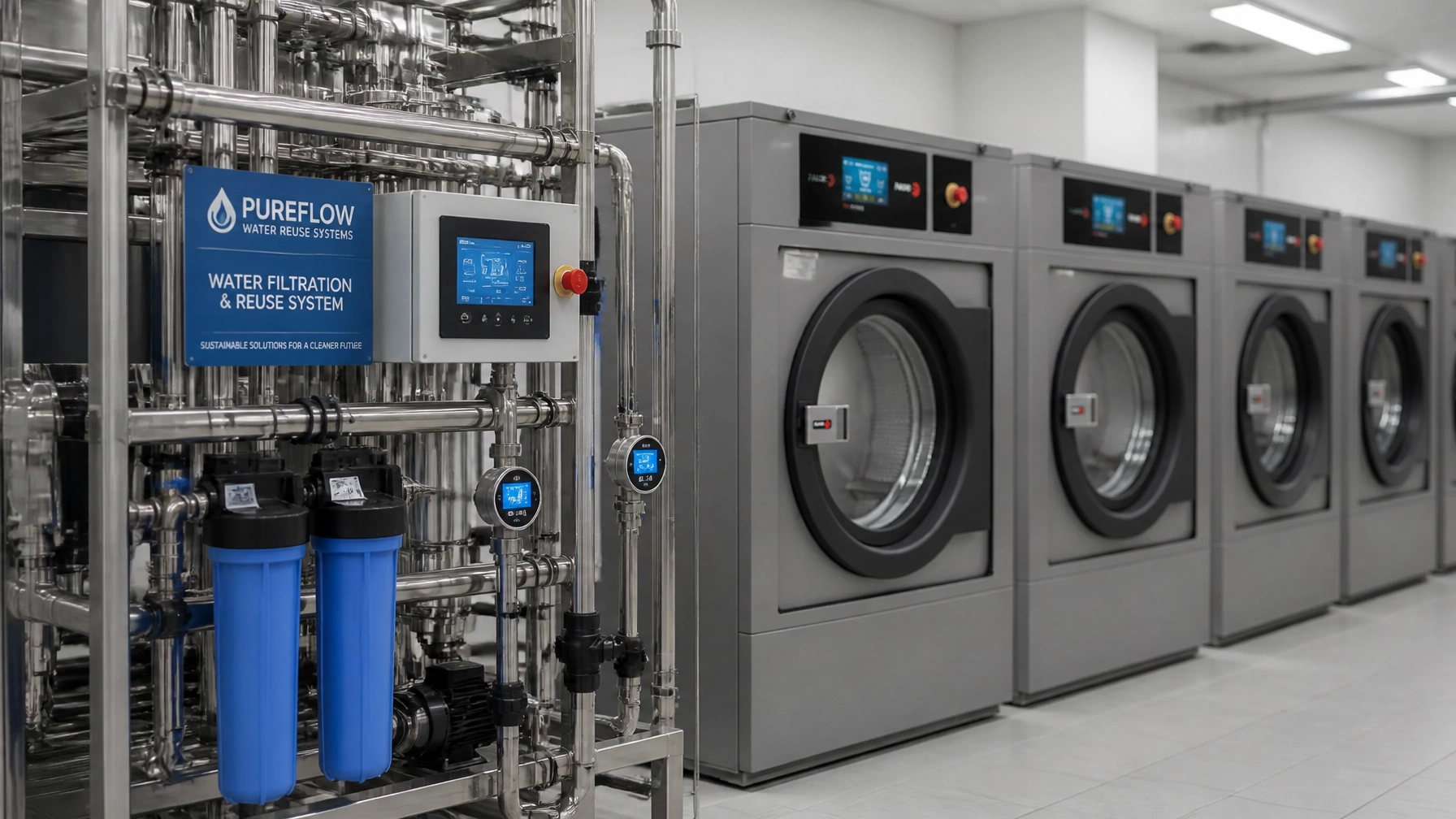
Water reuse systems represent a significant advancement in industrial laundry equipment design. Rather than discarding effluent, these systems capture the water from the rinse and wash cycles, processing it through a multi-stage filtration and disinfection sequence.
Modern recycling skids utilize technologies such as:
- Lint and Particle Filtration: Removing physical debris to protect internal components and maintain textile quality.
- Microfiltration: Eliminating finer contaminants that standard filters might miss.
- Disinfection (Ozone or UV): Ensuring the water is microbiologically safe for reuse, often exceeding the cleanliness standards of the initial municipal supply.
- Heat Recovery: Perhaps the most vital financial component, these systems allow the retained heat from the previous cycle to be transferred to the next, drastically reducing the energy load on boilers and water heaters.
By closing the loop, a facility can reuse up to 80% of its process water. This means that instead of pulling 100% fresh water for every cycle, the municipal supply only needs to provide a small "top-off" to account for evaporation and minimal discharge.
Direct Comparison: Standard vs. Reuse Systems
To understand the necessity of this transition, one must look at the hard data. The table below outlines the typical performance metrics of a standard industrial laundry operation compared to one equipped with a modern water reuse system.
| Metric | Standard System | Water Reuse System |
|---|---|---|
| Freshwater Consumption | 100% per cycle | 15% – 30% per cycle |
| Sewer Discharge | ~100% of intake | ~5% – 20% of intake |
| Water Heating Energy | High (Fresh heating required) | Low (Retained heat utilized) |
| Chemical Consistency | Variable based on intake | High (Stabilized recycled water) |
| Operational Efficiency | Baseline | Exceptional |
These reductions are not merely incremental; they are transformative. Industry data suggests that a high-volume facility can reduce its water and sewer costs by 60% to 80% and its energy costs for water heating by 15% to 50%.

The Financial Impact: ROI and Utility Bill Management
For a facility manager, the primary question is always: "When will this pay for itself?" In many high-utility-cost regions, the simple payback period for a water reuse system is remarkably short: often between 12 and 36 months.
Consider a hotel laundry facility that processes 1.5 million pounds of linen per year. By implementing a recycling system, the facility might save over 5 million gallons of water annually. When factoring in the reduced sewer surcharges and the decrease in therms used for water heating, the annual savings can reach well into the six figures.
Furthermore, these systems provide a level of "utility insurance." As municipal water rates continue to rise: often at a pace exceeding standard inflation: a facility that reuses its water is insulated from these price hikes. The operational efficiency gained through these systems provides a predictable, stable cost structure that is essential for long-term financial planning.
Enhancing Operational Resilience and Quality
Beyond the balance sheet, water reuse systems offer vital operational advantages.
- Compliance and Sustainability: Many municipalities are placing stricter limits on wastewater discharge. A reuse system allows a facility to meet these environmental standards without sacrificing throughput.
- Consistent Wash Quality: Advanced filtration often results in water that is softer and cleaner than the local municipal supply. This can lead to a reduction in chemical usage and an extension of the life of the linens themselves.
- Space and Design Optimization: At Wash IQ, our design services ensure that these systems are integrated seamlessly into your existing layout, maximizing every square foot of your facility.

Implementing the Solution: The Wash IQ Advantage
Transitioning to a water reuse model requires more than just purchasing equipment; it requires a comprehensive strategy. As a one-stop shop for all laundry needs, Wash IQ provides the expertise necessary to navigate this transition. From conducting initial efficiency reports to determine your potential savings, to providing ongoing repair and maintenance services for all brands of equipment, we ensure your investment is protected.
Our commitment to a 3-year parts and labor warranty on our industrial laundry equipment reflects our confidence in the durability and reliability of the solutions we provide. We understand that in an industrial setting, downtime is not an option.
Conclusion: A Vital Standard for the Modern Facility
In the world of commercial laundry, the choice is becoming clear: continue with the inefficient, resource-heavy models of the past, or embrace the technical superiority of water reuse. The impact on utility bills is immediate and significant, but the long-term benefits of operational efficiency, environmental compliance, and predictable cost management are even more compelling.
As you look to optimize your facility’s performance, consider the impact that a closed-loop water system could have on your bottom line. At Wash IQ, we have the 50 years of experience and the specialized knowledge to help you make that change.

For a personalized analysis of your current utility consumption and a custom proposal for improving your laundry room’s efficiency, contact our team today.