RFID Tracking for Linen Loss: Does It Really Pay Off?
In today’s competitive market, the margins of commercial laundry operations, hospitality groups, and healthcare facilities are under constant pressure. While much attention is directed toward energy consumption and labor costs, a silent drain on profitability often goes overlooked: linen loss. In the world of industrial laundry, "shrinkage" is more than a minor inconvenience; it is a significant operational failure that can cost a single facility hundreds of thousands of dollars annually.
The introduction of Radio Frequency Identification (RFID) technology has been presented as the definitive solution to this challenge. However, for facility managers and business owners, the vital question remains: Does the investment in RFID tracking truly pay off? To answer this, one must move beyond the technical novelty and analyze the concrete impact on operational efficiency, inventory lifespan, and long-term ROI.
The Magnitude of Linen Shrinkage
Before evaluating the solution, it is essential to quantify the problem. In the industrial laundry sector, textile loss is frequently the single largest controllable cost. Statistical data indicates that hospitals often lose between 5% and 15% of their total linen inventory every year. In the hospitality sector, these figures are even more pronounced; hotels and resorts frequently witness an annual attrition rate of 15% to 25% on high-value items such as towels, robes, and premium bed linens.
Across the United States alone, hospital linen shrinkage is estimated to reach nearly $1 billion annually. This loss is rarely the result of a single catastrophic event. Instead, it is a "death by a thousand cuts" caused by theft, hoarding at the ward or room level, accidental disposal in biohazard bins, and misrouting during transport. Without a robust tracking mechanism, these items simply vanish from the balance sheet, necessitating frequent and expensive replacement orders that disrupt budget planning.
How RFID Transforms Laundry Operations
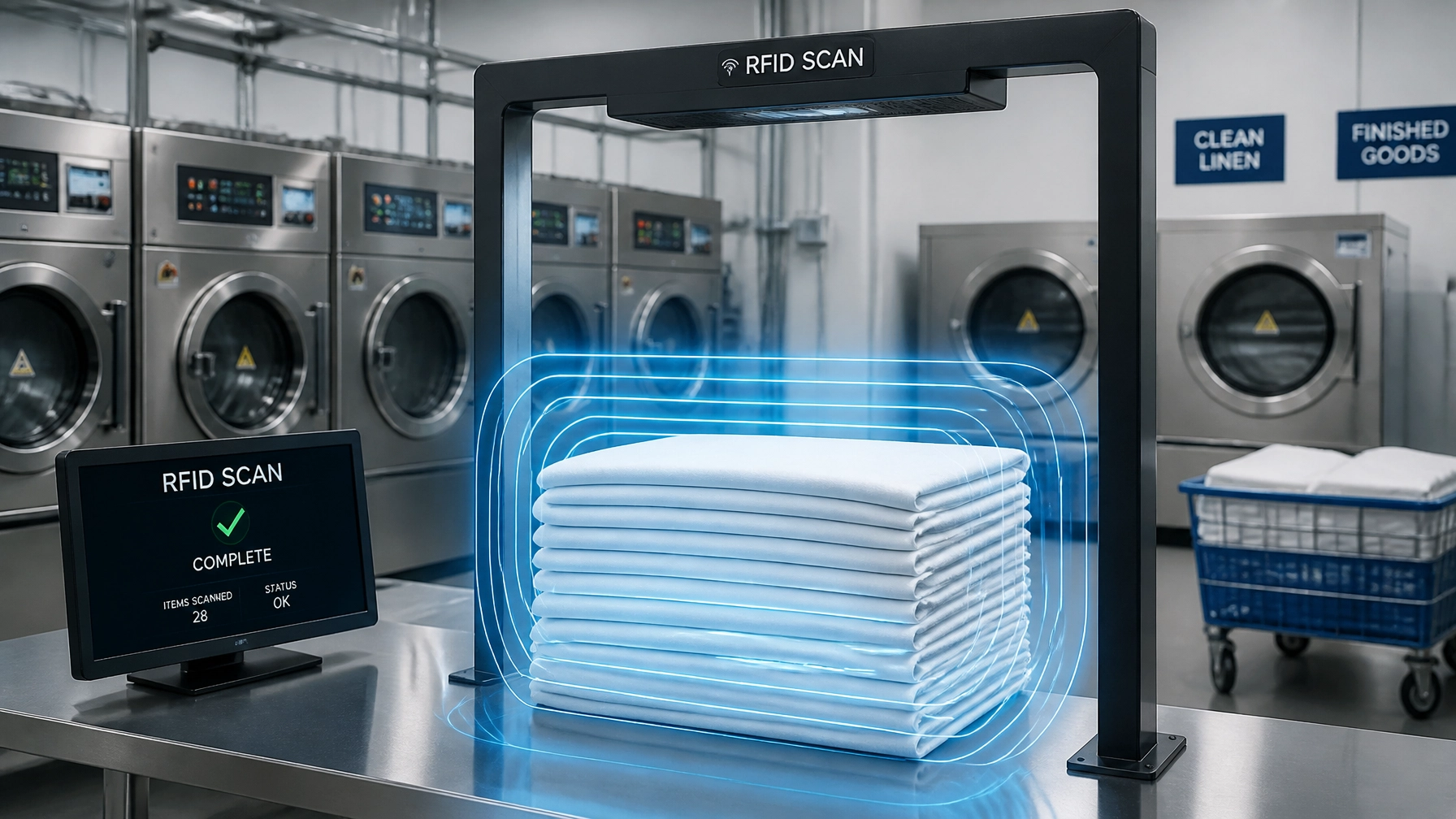
RFID technology functions by embedding a small, durable, and wash-resistant transponder: an RFID tag: into each textile item. Unlike barcodes, which require a direct line of sight and individual scanning, RFID tags can be read in bulk.

When a cart filled with hundreds of soiled linens passes through a scanning portal or is checked with a handheld reader, the system identifies every unique item instantly. This provides a level of visibility that was previously impossible. At Wash IQ, we recognize that visibility is the first step toward optimization. By integrating these technical tools, facilities can move from reactive replacement to proactive management.
The Core Benefits of Implementation
- Near-Total Accuracy: RFID systems typically deliver scan accuracy rates exceeding 99%. This eliminates the human error inherent in manual counting and provides a reliable audit trail for every item in the facility.
- Labor Efficiency: Automated bulk scanning reduces manual counting labor by an estimated 70% to 90%. Instead of staff spending hours reconciling inventories, they can be redirected to higher-value tasks, such as quality control or equipment maintenance.
- Enhanced Accountability: When every movement of a linen item is recorded: from the guest room to the soiled collection point, through the wash cycle, and back to the clean storage: the "chain of custody" is unbreakable. This transparency discourages theft and identifies exactly where bottlenecks or losses are occurring.
Analyzing the Return on Investment (ROI)
The primary barrier to RFID adoption is the initial capital expenditure. The cost of tags, readers, software integration, and staff training can be significant. However, a rigorous financial analysis reveals that the payback period is often shorter than expected.
Industry benchmarks suggest that most facilities achieve a full ROI within 8 to 18 months. For high-volume operations, such as a 500-bed hospital or a large-scale commercial laundry plant, the savings are immediate. For instance, if a facility with a $300,000 annual linen replacement budget utilizes RFID to reduce loss by just 30%, the direct savings amount to $90,000 per year. When combined with labor savings and extended textile life, the financial argument becomes undeniable.
Extending Textile Lifespan
An often-overlooked benefit of RFID is its ability to track wash counts. Every textile has a finite lifespan determined by the number of times it can be processed before quality degrades. RFID systems allow managers to monitor the "age" of their inventory. By ensuring proper rotation, facilities prevent certain items from being over-processed while others sit idle. This balanced usage typically extends the average lifespan of linens by 15% to 25%, further reducing the frequency of capital-intensive replacement cycles.

Reliable equipment is the backbone of this process. Utilizing heavy-duty machines, such as the industrial-grade solutions provided by Wash IQ, ensures that the washing process itself is consistent, allowing the RFID data to accurately reflect the true condition of the textiles.
Operational Excellence and Compliance
In specialized sectors like healthcare, RFID tracking is not merely about cost: it is a matter of compliance and safety. The ability to track the sterilization history of a specific gown or sheet is crucial for meeting hygiene standards. In the event of a contamination concern, RFID allows for immediate isolation of affected batches, a process that would take days if performed manually.
Furthermore, for commercial laundries serving multiple clients, RFID is vital for billing accuracy. Traditional "weight-based" billing is often the subject of disputes between the laundry and the client. Item-level tracking allows for precise, auditable invoicing. This transparency builds trust and improves client retention, positioning the laundry as a professional partner rather than a mere service provider.
Challenges and Considerations
While the benefits are significant, implementation requires a strategic approach. It is essential to consider:
- Integration: The RFID software must communicate seamlessly with existing ERP or management systems.
- Tag Durability: Not all tags are created equal. It is vital to select tags rated for the high temperatures and chemicals used in industrial laundry.
- Change Management: Staff must be trained to use the new system. Behavioral change is just as important as technical installation.

At Wash IQ, we assist facilities in navigating these complexities through our comprehensive design services and efficiency reports. We analyze your specific operational footprint to identify whether RFID is the right move for your current scale.
The Professional Verdict
Does RFID tracking for linen loss pay off? The answer, for most industrial-grade operations, is a definitive yes. While the upfront investment is noteworthy, the long-term protection of your textile assets and the dramatic reduction in labor costs provide a compelling business case.
In an era where operational efficiency defines the difference between growth and stagnation, ignoring a 20% loss in your inventory is no longer an option. RFID technology transforms linens from a "consumable expense" back into a "managed asset."
For businesses seeking to optimize their laundry operations, the path forward involves a combination of high-quality equipment and smart tracking technology. Whether you are managing a boutique hotel or a multi-site hospital network, the goal remains the same: maximum throughput with minimum waste.

If you are ready to stop the drain on your profits, consider a professional evaluation of your current inventory management. The transition to an RFID-enabled facility is a significant step toward achieving the operational excellence that modern industry demands.