Are Manual Laundry Shifts Dead? Why 2026 is the Year of the ‘Dark Factory’
In today’s competitive market, the industrial laundry sector is witnessing a paradigm shift that was once reserved for science fiction. In the world of high-volume linen processing, the concept of the "Dark Factory": a facility capable of operating fully or semi-autonomously with minimal human intervention: has transitioned from an experimental pilot to a vital operational standard. As we move through 2026, the question is no longer whether automation is possible, but rather how quickly a facility can integrate these "lights-out" capabilities to remain financially viable.
For decades, laundry managers have grappled with the "4D" challenges: tasks that are dark, dirty, dull, or dangerous. These roles, particularly those on the graveyard shift, are increasingly difficult to fill and even harder to retain. The rise of the Dark Factory offers a definitive solution, leveraging robotics, IIoT (Industrial Internet of Things), and sophisticated buffering systems to ensure that production never stops, even when the lights go out.
The Anatomy of a 2026 Dark Factory
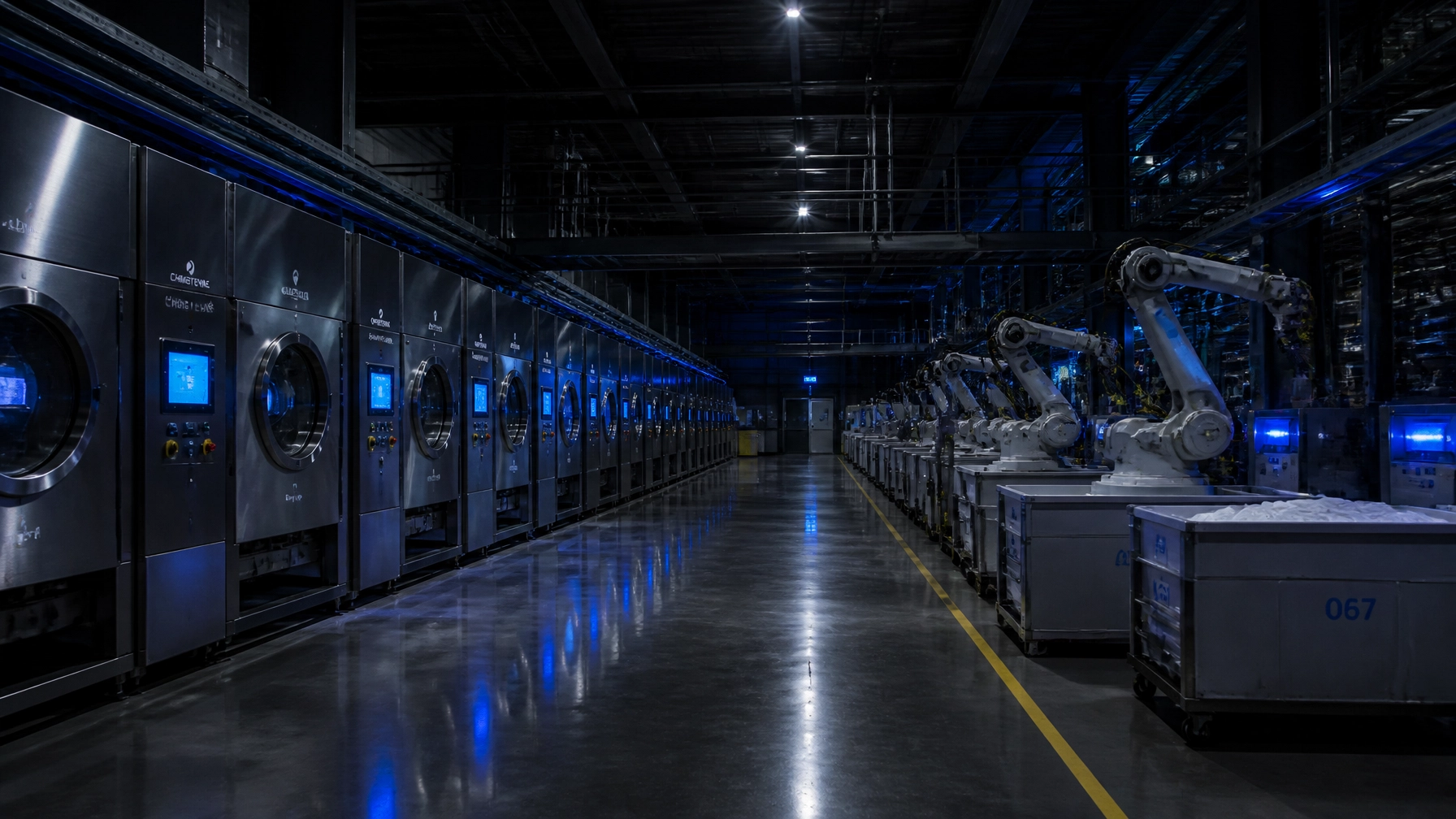
The term "Dark Factory" does not necessarily imply a building devoid of humans 24/7. Instead, it refers to a strategic operational model where high-impact, repetitive stages of the laundry cycle: sorting, buffering, and tunnel washing: are handled by machines during off-peak hours.
In a typical 2026 setup, a skeleton crew might load a main buffer in the late afternoon. From that point, AI-driven systems take over. These systems automatically sort and store laundry in front of the tunnel washers, feeding them at precise intervals throughout the night. By the time the morning shift arrives, hours of production have already been completed. This eliminates the traditional "startup lag" and ensures that finishing equipment is fed immediately upon the staff's arrival.

Why 2026 is the Tipping Point
Several factors have converged to make this the year of the Dark Factory. First and foremost is the persistent labor scarcity. With rising wages and a shrinking pool of workers willing to perform manual laundry labor, automation has become an essential investment rather than a luxury.
Furthermore, the reliability of industrial laundry equipment has reached a level where unattended operation is safe and predictable. Brands like B&C Technologies, Milnor, and Fagor have integrated advanced sensors that monitor everything from water pressure to motor temperature in real-time. If a machine detects a potential failure, it can automatically pause the cycle and send an alert to a remote technician, preventing the catastrophic downtime that used to haunt facility managers.
The Financial Imperative
From a business-centric perspective, the ROI of a Dark Factory model is undeniable. By extending production into the night without adding labor costs, facilities can:
- Increase Throughput: Process more kilograms per day using the same physical footprint.
- Reduce Utility Waste: Modern automated systems are far more precise in their water and chemical usage than manual operations.
- Improve Equipment Longevity: Consistent, machine-led loading prevents the "feast or famine" cycles that put unnecessary strain on motors and bearings.
The Role of IoT and Predictive Maintenance
In the world of 2026, "Expert Repair" is no longer about fixing what is broken; it is about preventing the break from ever occurring. The backbone of the Dark Factory is a robust IoT network. Every piece of equipment, from your front-loading industrial washers to your high-capacity dryers, is a data point.

At Wash IQ, we have seen that the most successful facilities are those that utilize our Efficiency Reports to identify bottlenecks before they become crises. In a Dark Factory environment, these reports are the "eyes" of the manager. They provide a high-level overview of operational health, allowing for a proactive approach to maintenance. When you can see that a belt on a dryer is beginning to slip via a digital dashboard, you can schedule a repair during a planned lull, rather than suffering an emergency shutdown during peak volume.
Integration of Chemical Optimization
One might assume that automation is purely mechanical, but the chemical aspect is equally crucial. A Dark Factory requires a "set it and forget it" chemical delivery system that is both precise and reliable. Over-sudsing or improper pH levels can ruin a night’s worth of production if there isn't a human there to spot the error.
This is where Chemical Cost Optimization becomes a strategic advantage. By using closed-loop systems and high-quality concentrates, businesses can ensure that every load is treated with the exact volume of detergent and sanitizer required. This consistency is the secret to maintaining linen life and meeting the rigorous hygiene standards of hospitals and hotels.

Designing the Future: Beyond the Machines
Transitioning to a highly automated or Dark Factory model requires more than just buying new machines. It requires a fundamental rethink of your facility’s layout. This is where Design Services play a vital role.
The flow of linen: from the soiled dock to the clean storage: must be optimized for robotic transport and automated conveyor systems. If the layout is inefficient, even the most advanced Milnor or Yamamoto folder won't reach its full potential. At Wash IQ, we help facility managers map out these transitions, ensuring that the integration of automation doesn't lead to new, unforeseen bottlenecks.
The "Smart" Efficiency Dashboard
The modern laundry manager's most powerful tool is no longer a clipboard; it’s a dashboard. In 2026, real-time data visualization allows for a level of control that was previously impossible. You can monitor your entire fleet’s performance from a smartphone, adjusting chemical dosages or cycle times on the fly.

Is the Human Element Obsolete?
It is a common misconception that the Dark Factory makes humans obsolete. In reality, it elevates the human role. Instead of performing back-breaking manual labor, your staff becomes a team of "System Overseers." They focus on programming, quality control, and high-level maintenance.
This shift not only improves the safety and ergonomics of the workplace but also makes the laundry industry a more attractive career path for a technically-minded workforce. The goal isn't to remove people; it's to remove the burden of the shift from the people.
Conclusion: A Direct Path to Operational Excellence
In the world of 2026, the "Dark Factory" is the standard of excellence for any industrial laundry facility that intends to thrive. The combination of expert repair services, advanced equipment like Fagor and B&C, and data-driven chemical optimization creates a resilient, high-output environment that is shielded from the volatility of the labor market.
At Wash IQ, we pride ourselves on being a one-stop shop for this transition. Whether you are managing a single-site banquet hall or a multi-state hospital network, the move toward automation is the most important strategic decision you will make this decade. The manual laundry shift isn't just dying; it’s evolving into something faster, smarter, and far more profitable.