Can RFID Tracking Really Help You Stop Linen Loss? Find Out Here
In today’s competitive market, the management of operational assets has transitioned from a routine administrative task to a vital strategic imperative. For high-volume facilities such as hotels, hospitals, and banquet halls, textiles represent a significant portion of annual capital expenditure. However, the phenomenon of "linen shrinkage": the unaccounted loss of towels, bedsheets, and robes: continues to erode profit margins across the industry. As operational costs rise, the question for facility managers is no longer just how to wash linens more efficiently, but how to ensure they remain within the facility’s inventory.
In the world of industrial laundry, RFID (Radio Frequency Identification) tracking has emerged as a crucial solution to this perennial challenge. By transforming textiles into traceable assets, this technology promises to eliminate the mystery of where linens disappear. But can a small electronic tag truly solve the problem of linen loss? The evidence suggests that for facilities committed to operational excellence, RFID is an essential tool for long-term sustainability.
The Magnitude of the Linen Loss Problem
For many hospitality and healthcare organizations, linen loss is often treated as an "unavoidable cost of doing business." Statistics, however, reveal that this cost is far more substantial than most realize. It is common for facilities to experience an annual shrinkage rate between 15% and 25%. In a mid-sized hospital or a large resort, this equates to hundreds of thousands of dollars in lost capital every single year.
Linen loss typically occurs in three primary areas:
- Unauthorized Removal: Guests or staff inadvertently or intentionally removing items from the premises.
- Process Errors: Linens being discarded improperly or lost during the transit between the facility and an outsourced laundry provider.
- Inventory Mismanagement: Items being "hoarded" in specific departments, leading to a perceived shortage and unnecessary additional purchasing.
Without a robust tracking system, identifying the exact point of failure is nearly impossible. This is where Wash IQ advocates for a data-driven approach. Integrating technology into your industrial laundry equipment setup is no longer an optional upgrade; it is an important step toward securing your bottom line.
How RFID Tracking Operates in a Laundry Environment
To understand the impact of RFID, one must first understand the technical mechanism. Unlike traditional barcodes, which require a direct line of sight and individual scanning, Ultra-High Frequency (UHF) RFID tags can be read in bulk without being visible.

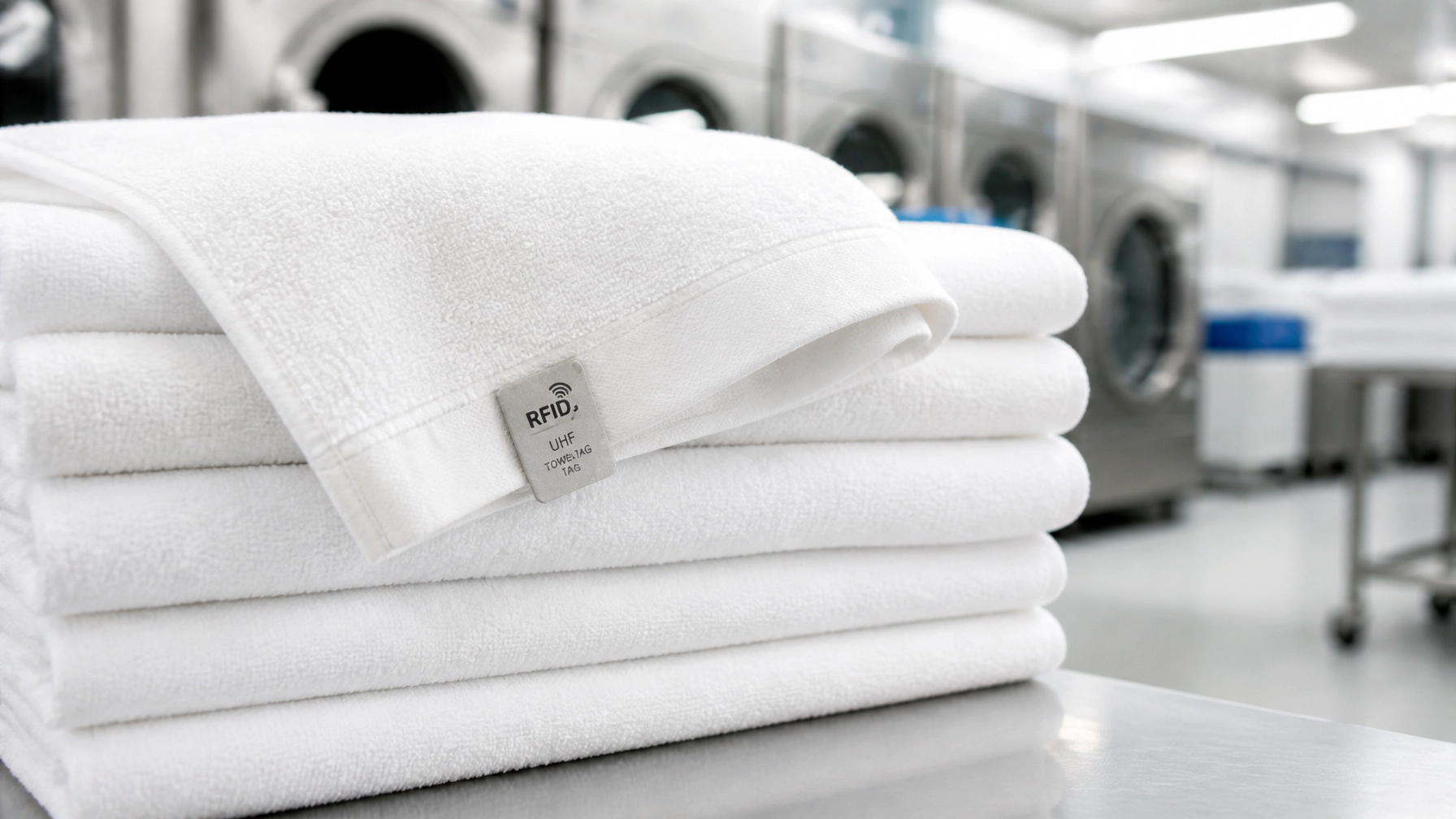
Each linen item is equipped with a small, flexible, and highly durable tag designed to withstand the rigorous conditions of industrial washing, including high temperatures, chemical exposure, and high-pressure extraction. As these items move through the facility, they pass through "zones" equipped with RFID readers and antennas.
These readers can scan hundreds of items in seconds. Whether the linens are in a laundry cart, a closet, or a delivery truck, the system maintains a real-time record of their location. This level of transparency is vital for establishing a clear chain of custody, ensuring that every item sent to the wash is eventually returned to service.
Crucial Benefits of Implementing RFID Tracking
The implementation of RFID technology offers more than just loss prevention; it provides a comprehensive overhaul of laundry room efficiency.
1. Drastic Reduction in Replacement Costs
The primary driver for RFID adoption is the immediate impact on purchasing budgets. Documented case studies show that RFID deployments can reduce linen loss by 20% to 50%. By identifying exactly where items are leaving the system, management can implement targeted interventions, such as improved security at exit points or better staff training in specific departments.
2. Elimination of Manual Counting
In a traditional setting, inventory audits and the counting of outgoing or incoming laundry are labor-intensive tasks prone to human error. RFID technology automates this process entirely. A task that once took multiple employees several hours can now be completed in minutes with 99% accuracy. This labor efficiency is essential for facilities struggling with staffing shortages, allowing personnel to focus on higher-value tasks.
3. Optimized Inventory (Par) Levels
Many facilities maintain excessive "par levels": essentially overstocking linens to compensate for perceived shortages. This ties up significant working capital in inventory that may not be needed. Because RFID provides total visibility, managers can operate with leaner, more accurate inventory levels, often reducing par requirements by 15% to 25%.

Enhancing Textile Life Cycle Management
Beyond mere tracking, RFID technology allows for sophisticated life cycle management. Every time an item passes through the laundry cycle, the system records the wash count. This data is important for several reasons:
- Quality Assurance: Facilities can set alerts for when an item has reached its maximum recommended wash cycles, ensuring that guests always receive linens that meet brand standards.
- Warranty Verification: If a batch of linens fails prematurely, the RFID data provides irrefutable proof of the usage history, which is vital when pursuing warranty claims with manufacturers.
- Rotation Management: The system can identify "dead stock" that has been sitting in storage for too long, ensuring a proper first-in, first-out (FIFO) rotation that extends the overall life of the linen pool.
Integrating RFID with Industrial Laundry Equipment
For RFID to be truly effective, it must be integrated into a well-designed facility layout. At Wash IQ, we specialize in design services that optimize the flow of textiles from the moment they are soiled to the moment they are returned to the shelf.
When we install high-performance machinery, such as Milnor or Fagor washers, the inclusion of RFID portals at the intake and outflow points creates a "smart" laundry loop. This integration ensures that the efficiency of the machinery is matched by the accuracy of the inventory data. If your facility is currently struggling with unexplained costs, our efficiency reports can help pinpoint whether RFID is the missing piece of your operational puzzle.

The Financial Reality: ROI and Long-Term Value
The decision to adopt RFID tracking is a significant one, involving an initial investment in tags, readers, and software. However, the return on investment (ROI) is typically achieved within 12 to 18 months. When you consider the combined savings from reduced linen purchases, decreased labor costs, and lower inventory requirements, the financial argument becomes undeniable.
In the world of professional laundry management, ignoring technological advancement is a recipe for stagnation. Modern facilities must prioritize reliability and precision. By partnering with an expert like Wash IQ, which brings over 50 years of industry experience, you ensure that your transition to high-tech inventory management is seamless and successful.
Conclusion: A Standard for Modern Facilities
Can RFID tracking really help you stop linen loss? The answer is a definitive yes. It is a proven, reliable method for transforming textiles from a disappearing expense into a managed asset. For hotels, hospitals, and commercial laundries, the visibility provided by RFID is no longer a luxury: it is a competitive necessity.
As you look to optimize your facility in 2026 and beyond, consider the impact of total inventory transparency. Whether you are building a new facility or upgrading an existing one, the integration of tracking technology with premium industrial laundry equipment is the most effective way to ensure operational excellence.
If you are ready to eliminate the frustration of linen loss and take control of your facility's efficiency, contact the experts at Wash IQ. From initial design to expert repair and maintenance, we provide the comprehensive support required to keep your operation running at its peak.