Financing Your Laundry Upgrade: What Hotel and Hospital Owners Need to Know in 2026
In today’s competitive market, the efficiency of on-premise laundry (OPL) operations has moved from a back-of-house necessity to a critical driver of institutional profitability and patient care. For hotel and hospital owners, the decision to upgrade industrial laundry equipment is no longer merely about replacing aging machinery; it is a strategic financial maneuver designed to hedge against rising labor costs, volatile utility prices, and the increasing demand for hygiene excellence.
As we progress through 2026, the financial landscape for equipment procurement has evolved. Traditional purchasing models are being augmented by sophisticated financing structures, manufacturer incentives, and significant tax advantages. Understanding how to navigate these options is essential for facility managers and business owners looking to optimize their capital expenditure while ensuring long-term operational reliability.
The Shifting Financial Landscape of 2026
The commercial laundry industry in 2026 is characterized by a "multi-channel" approach to acquisition. Unlike previous decades where a simple bank loan was the standard, today’s owners are leveraging a blend of SBA-backed loans, manufacturer-specific rebates, and private equity partnerships.
For large-scale hospital laundry renovations or major hotel plant upgrades, SBA 7(a) and SBA 504 loans remain pivotal. These programs offer terms of up to 10 years for equipment: and up to 25 years if the project includes real estate improvements. This allows facilities to preserve their operating cash flow while building equity in high-value assets like industrial softmount washers and high-capacity ironers.
Furthermore, leading manufacturers such as Milnor, Fagor, and B&C are increasingly offering quarterly rebates. In 2026, many of these programs provide up to $1,000 per unit in direct rebates, which can significantly offset the initial down payment when combined with promotional interest rates (often structured at WSJ Prime + 2.49%).
Strategic Financing Options: Loans vs. Leases
Choosing between a loan and a lease is a foundational decision that impacts both the balance sheet and the facility’s long-term operational flexibility.
Equipment Loans
Traditional loans are the preferred route for established entities seeking to own their equipment outright. In 2026, lenders typically require 10–20% down, with the equipment itself serving as collateral. The primary benefit here is the accumulation of equity and the ability to utilize Section 179 tax deductions (discussed below).

Equipment Leasing
Leasing has gained traction among hotel owners who prioritize liquidity. Operational leases allow facilities to access the latest technology: such as IoT-enabled dryers: without a heavy upfront capital outlay. Leasing is particularly advantageous in environments where technology cycles are fast, as it provides a clear "refresh" path every five to seven years, ensuring the facility never falls behind in efficiency.
Maximizing ROI Through Advanced Technology
The Return on Investment (ROI) of a 2026 laundry upgrade is driven by three primary factors: labor reduction, utility efficiency, and predictive maintenance.
1. Counteracting Labor Scarcity
Labor costs continue to be the largest line item in any laundry operation. Modern industrial equipment is designed for high-capacity throughput with minimal human intervention. Features such as automated chemical injection and programmable cycles reduce the training time required for staff and minimize the risk of human error. By investing in high-G-force extraction washers, facilities can reduce drying times by up to 20%, directly lowering the man-hours required to process each pound of linen.
2. Utility Cost Mitigation
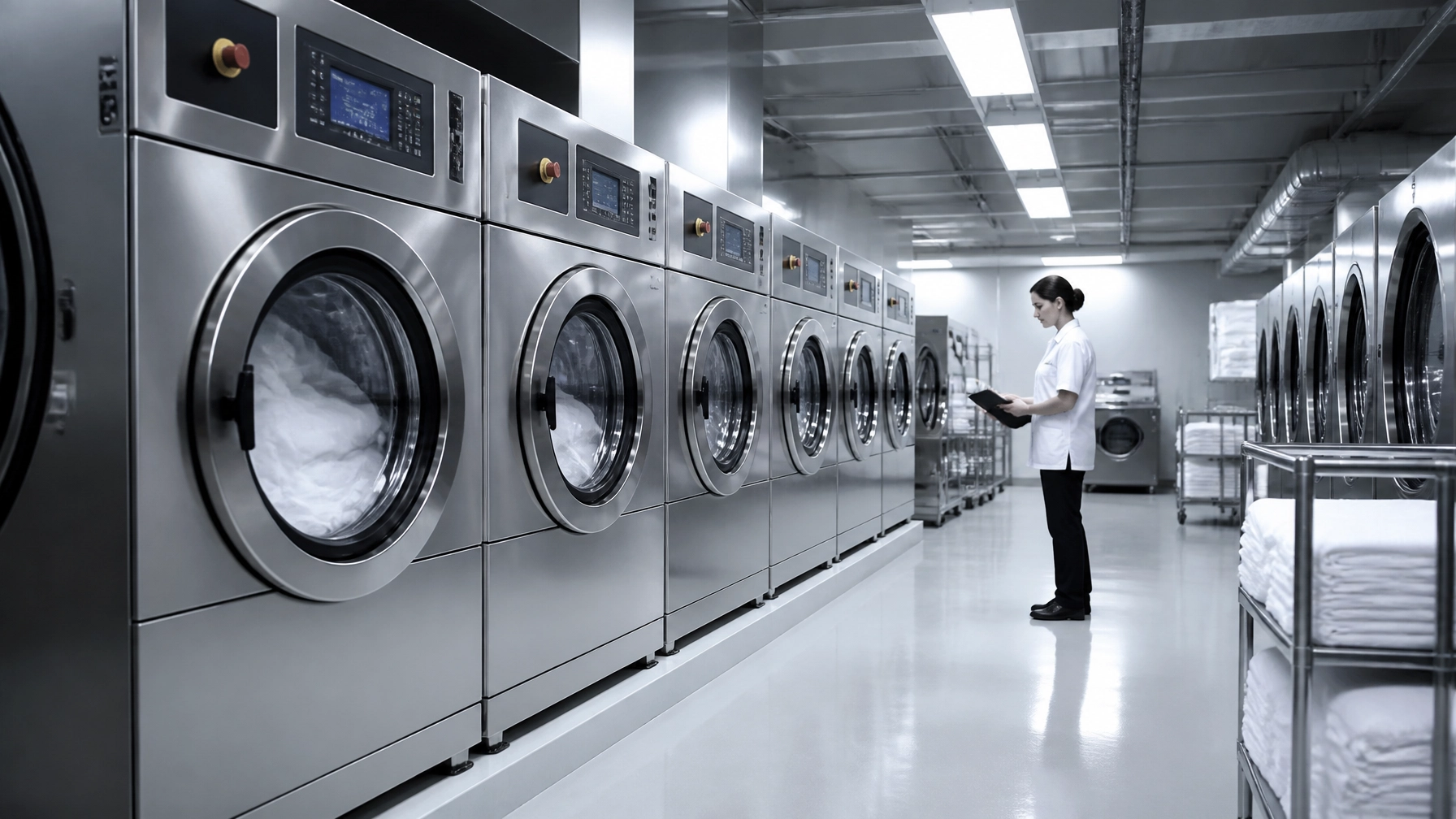
With energy and water rates remaining volatile, the efficiency of HP Series Washers is a vital component of the ROI calculation. Equipment that extracts more water in the spin cycle reduces the thermal energy required in the drying phase. Over a typical 7-year financing term, the utility savings alone can often cover a substantial portion of the monthly debt service.
3. IoT and Predictive Maintenance
The integration of Smart Laundry systems and IoT diagnostics has revolutionized how hospitals and hotels manage their fleets. Real-time alerts can identify a failing bearing or a clogged valve before it causes an unplanned shutdown. In a hospital setting, where linen availability is linked to infection control and patient throughput, the prevention of even a single day of downtime can save thousands of dollars in outsourced laundry costs.

Tax Advantages and Section 179
One of the most important financial tools for 2026 is the Section 179 deduction. This allows businesses to deduct the full purchase price of qualifying equipment: up to certain limits: during the tax year it is placed in service.
For a hotel or hospital purchasing $500,000 in new drying cabinets and flatwork ironers, the ability to write off the entire amount in year one can provide an immediate cash infusion via tax savings. This effectively reduces the "net cost" of the upgrade, accelerating the time-to-payback and improving the project’s internal rate of return (IRR).
The Cost of Inaction
While the capital investment for a laundry upgrade is significant, the cost of maintaining obsolete equipment is often higher. Aging machines consume more water, require more frequent (and expensive) repairs, and are more prone to catastrophic failure.
In the world of industrial laundry, a "break-fix" mentality is a recipe for operational failure. A sudden breakdown in a hospital’s barrier washer system can compromise sterile environments, while a hotel with a backlog of dirty linens will inevitably see its guest satisfaction scores plummet. Proactive financing and upgrading ensure that these risks are mitigated before they impact the bottom line.

Why Partner with Wash IQ?
At Wash IQ, we understand that every facility has unique operational and financial requirements. With over 50 years of industry expertise, we serve as a one-stop shop for business owners and facility managers. Our approach goes beyond equipment sales; we provide comprehensive efficiency reports and custom facility design services to ensure your investment is optimized from day one.
We offer:
- A Complete Line of Industrial Equipment: From Milnor to Fagor and B&C, we supply the most reliable brands in the industry.
- Chemical Cost Optimization: We help you reduce chemical expenses while enhancing product quality.
- Expert Repair and Maintenance: We service all brands, ensuring your equipment stays operational for the long haul.
- 3-Year Parts and Labor Warranty: We stand behind our products with industry-leading support.
Whether you are managing a single boutique hotel or a large multi-site hospital network, Wash IQ provides the technical expertise and financial guidance necessary to modernize your laundry operations successfully.
Conclusion
Financing a laundry upgrade in 2026 is a complex but rewarding endeavor. By leveraging modern lending structures, manufacturer rebates, and tax incentives, hotel and hospital owners can transform their laundry rooms from cost centers into high-efficiency assets. The key to success lies in selecting the right equipment and partnering with an expert who understands the intersection of technology and finance.
To explore how a custom equipment package can improve your facility’s ROI, contact Wash IQ today for a comprehensive efficiency analysis.