Used vs. New Industrial Laundry Equipment: Which One Actually Costs Less in the Long Run?
In today’s competitive market, facility managers and business owners are under constant pressure to optimize operational expenditures while maintaining peak performance. Within the world of industrial laundry, the decision to procure equipment is one of the most significant capital investments a facility will face. Whether you are managing a high-capacity hotel, a sterile hospital environment, or a large-scale commercial laundry plant, the choice between "used" and "new" machinery often boils down to a fundamental question: does a lower upfront price tag translate to actual long-term savings?
While the immediate cost reduction of pre-owned machinery is undeniably tempting, a comprehensive analysis of the Total Cost of Ownership (TCO) reveals a more complex reality. To make a fiscally responsible decision, one must look beyond the initial invoice and evaluate the vital factors of utility efficiency, maintenance frequency, and operational reliability.
The Allure and Risks of the "Upfront Discount"
For many organizations, the primary driver for considering used industrial laundry equipment is the preservation of liquid capital. It is common to find pre-owned units priced 40% to 60% lower than their brand-new counterparts. In the short term, this allows a business to expand its capacity or replace a failing machine with a significantly smaller initial hit to the balance sheet.
However, this "upfront discount" is often a strategic illusion. Industrial laundry equipment is designed for rigorous, high-volume use. When a machine is sold on the secondary market, it has typically already endured years of mechanical stress. Without a documented service history or a comprehensive manufacturer-backed warranty, the buyer assumes a substantial amount of financial risk. In the industrial sector, an asset that is inexpensive to acquire but expensive to operate is not a bargain: it is a liability.
Utility Consumption: The Invisible Operational Drain
In any large-scale laundry operation, utility costs: water, sewer, gas, and electricity: represent a significant portion of the monthly overhead. In the world of modern engineering, the technological gap between a machine manufactured today and one from even a decade ago is immense.

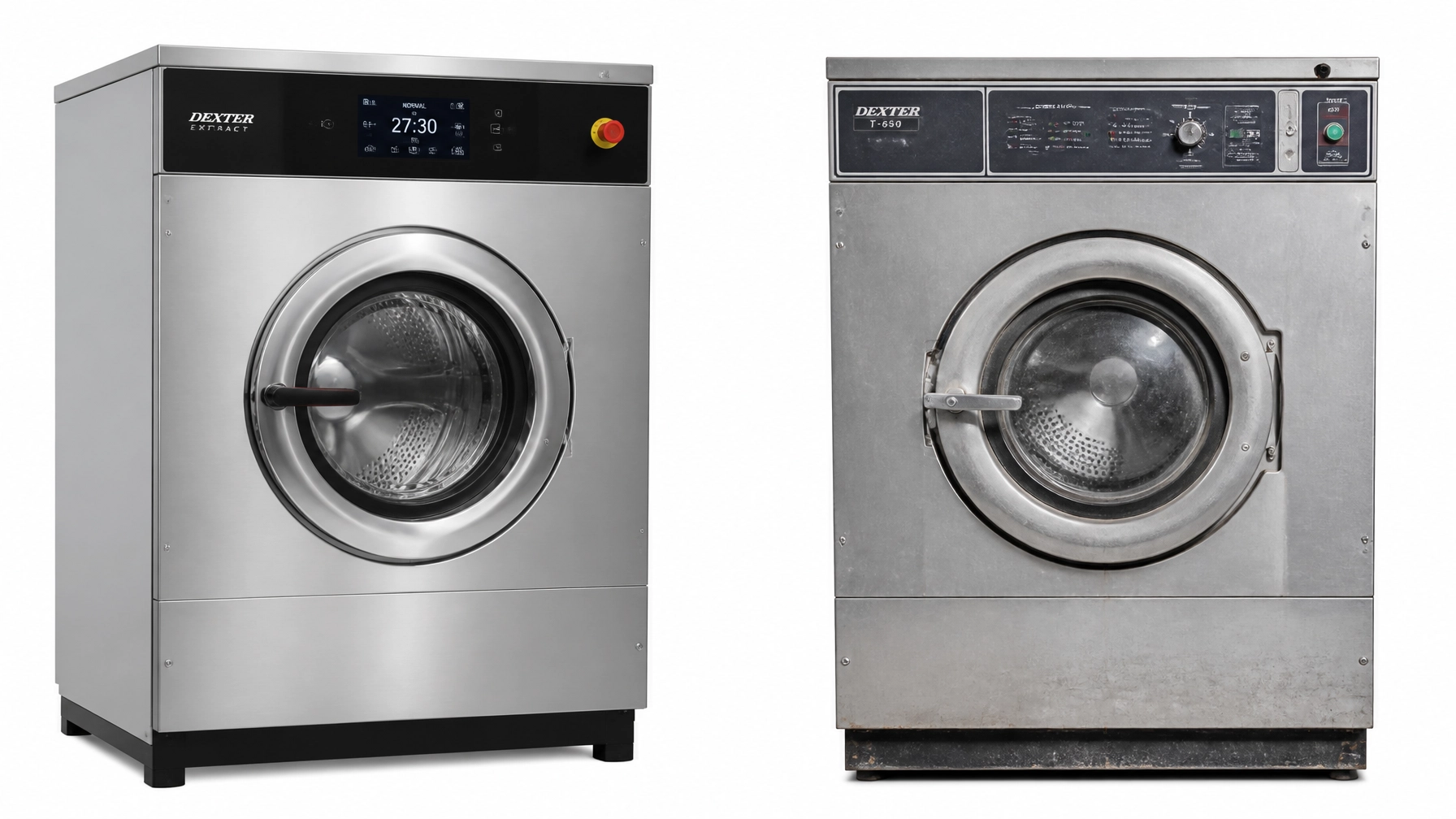
Modern units, such as the Wash IQ HE-Series Washers and the HP-Series Washers, are engineered specifically to minimize resource consumption. These machines utilize advanced water-level sensors and high-speed extraction capabilities that significantly reduce the amount of water used per pound of linen.
By contrast, older used machines often operate on outdated wash cycles and lower G-force extraction. This results in two major financial drains:
- Higher Water and Sewer Bills: Older machines may use 20% to 30% more water per cycle compared to modern high-efficiency models.
- Increased Drying Times: Inefficient extraction leaves more moisture in the fabric, forcing your industrial dryers to run longer and consume more gas or electricity.
Over a 7-to-10-year lifespan, the cumulative cost of these extra utility expenses can easily exceed the original price difference between a new and used machine.
Maintenance, Repair, and the "Expert Repair" Advantage
Reliability is an essential component of professional laundry management. A new machine comes with the assurance of pristine components and, crucially, a comprehensive warranty. At Wash IQ, we provide a 3-year parts and labor warranty on our equipment, providing business owners with predictable maintenance costs and total peace of mind.

When you purchase used equipment, you are often purchasing someone else’s maintenance backlog. Older machines are prone to frequent mechanical failures, ranging from bearing issues to motor burnouts. These repairs are not only costly in terms of parts but also in terms of labor. Finding parts for discontinued or older models can be difficult, leading to extended periods where the machine is non-functional.
While our team at Wash IQ has over 50 years of experience in repair and maintenance services for any brand, the most efficient repair is the one that is never needed. By investing in new equipment, you are essentially "pre-paying" for a decade of reliability, whereas used equipment requires a continuous and unpredictable stream of repair invoices.
The True Cost of Downtime
In an industrial setting, downtime is a silent profit killer. If a hospital’s laundry facility goes down, patient care is compromised. If a hotel cannot produce clean linens, room turnover stalls, directly impacting revenue.
When a used machine fails, the cost is not just the technician’s hourly rate; it is the cost of:
- Lost Productivity: Employees standing idle while waiting for equipment to be repaired.
- Outsourced Services: The high cost of emergency linen services to bridge the gap.
- Customer Dissatisfaction: Potential loss of business due to service delays.
New equipment is statistically more likely to maintain high uptime. Furthermore, modern digital controls allow for better monitoring and predictive maintenance, ensuring that potential issues are identified before they lead to a total system failure.
Strategic Procurement: Beyond the Machine
Choosing the right equipment is only one part of the equation. Achieving the lowest TCO requires a holistic approach to facility management. This is where professional design services and efficiency reports become vital.

A new equipment purchase from Wash IQ includes access to our expertise in optimizing your entire operation. We don't just sell machines; we provide a complete solution that includes:
- Chemical Cost Optimization: Ensuring your machines use the precise amount of detergent to protect your linens and your budget.
- Facility Layout Design: Optimizing the "flow" of laundry to reduce labor costs and improve throughput.
- Operational Training: Ensuring your staff knows how to operate new technology for maximum longevity.
Final Verdict: Which One Costs Less?
To determine the true winner, we must look at the 10-year horizon.
- Used Equipment: Low initial cost + high utility bills + frequent repairs + downtime risk + zero resale value.
- New Equipment: Higher initial cost – utility savings – zero repair costs (under warranty) + high reliability + higher resale value.
In almost every industrial application, new equipment delivers a significantly lower Total Cost of Ownership. The initial premium paid for new technology is an investment that pays dividends through reduced monthly overhead and the prevention of catastrophic operational failures.

At Wash IQ, we are committed to being your one-stop shop for all industrial laundry needs. Whether you are looking for high-capacity washers, ironers, or even ice equipment for banquet settings, we provide the expertise to ensure your facility operates at peak efficiency.
Don't let a "bargain" price tag jeopardize your long-term success. Choose the reliability and efficiency that comes with 50 years of industry experience.