High-Extraction Washers vs. Standard Washers: Which Is Better for OPL Laundry Solutions?
Part of the Industrial Laundry Operational Excellence & Equipment Guides series
In today’s competitive market, facility managers must evaluate more than the purchase price of a washer. The right equipment affects drying time, utility consumption, labor productivity, linen life, and the facility’s ability to meet daily turnaround requirements.
For hotels, hospitals, banquet halls, and commercial laundries, the central question is often whether to invest in a high-extraction washer or select a standard washer with a lower initial cost.
The answer depends on your laundry volume, facility design, available utilities, textile mix, and operating priorities. In many high-volume OPL laundry solutions, high-extraction equipment delivers the strongest long-term value. However, standard washers remain practical for smaller operations, lighter soil loads, and facilities with strict capital constraints.
What Does High-Extraction Mean?
High-extraction refers to a washer’s ability to remove water mechanically during the final spin. This performance is measured primarily by G-force, which describes the acceleration applied to the load relative to normal gravity.
A washer operating at 450 G applies an extraction force many times greater than a conventional machine operating at approximately 90–200 G. Higher G-force generally pushes more water through the drum perforations before the load enters the dryer.
The result is lower residual moisture content, also called moisture retention. Residual moisture is the amount of water remaining in the textiles after extraction, expressed as a percentage of the dry textile weight.
Typical ranges vary by machine design, fabric, cycle programming, and load conditions. As a general comparison:
| Washer category | Typical extraction range | Typical operating effect |
|---|---|---|
| Standard or low-extract washer | Approximately 90–140 G | Leaves more water in the load and increases dryer demand |
| Hard-mount commercial washer | Approximately 150–200 G | Provides moderate extraction but requires floor anchoring |
| Soft-mount high-extraction washer | Approximately 300–450 G | Removes substantially more water and supports faster drying |
These figures are guidelines rather than guarantees. Facility managers should request verified residual moisture data for the actual textiles being processed.
How Extraction Affects Drying Time and Utility Costs
Dryers remove moisture with heat and airflow. Washers remove moisture mechanically. Mechanical extraction is usually more efficient than evaporating the same amount of water in a heated dryer.
A load leaving a standard washer may retain approximately 60–75% moisture, depending on the fabric and extraction cycle. A properly loaded high-extraction washer may reduce that figure to approximately 40–45% or lower for some textiles.
That difference has a direct effect on the rest of the laundry operation.

Lower dryer operating time
High-extraction washers can reduce the amount of water the dryer must remove. In practical terms, this can shorten drying cycles, especially for absorbent items such as:
- Cotton towels
- Hotel sheets and pillowcases
- Healthcare gowns and patient linens
- Banquet table linens
- Cleaning cloths and mops
- Workwear and uniforms
Published commercial laundry comparisons have reported drying-time reductions of approximately 30–50% when moving from low extraction to high extraction. Actual savings depend on dryer condition, airflow, fabric type, load size, temperature, and moisture-sensing controls.
Even a modest reduction becomes significant when multiplied across daily production. If a facility saves eight minutes across 20 dryer cycles, it releases more than two and a half hours of dryer capacity each day. That additional capacity can reduce overtime, prevent production backlogs, and support faster linen turnaround.
Lower gas, electric, or steam consumption
Shorter dryer cycles also reduce fuel and energy use. The exact savings should be calculated using your facility’s utility rates and operating schedule, but high extraction can help reduce:
- Natural gas consumption
- Electric dryer demand
- Steam usage
- Heat loss through exhaust systems
- Dryer component wear
- Labor associated with waiting and reprocessing
A high-extraction washer may use slightly more energy during its final spin than a lower-speed washer. However, the additional washer energy is usually much smaller than the energy required to evaporate the extra water in a dryer.
For this reason, the washer and dryer should be evaluated as one system. The lowest-cost washer is not always the lowest-cost laundry solution.
Capacity and Throughput: Look Beyond Pounds per Load
High-extraction and standard washers may be available in similar rated capacities. Capacity alone, therefore, does not determine throughput.
The more important question is how quickly a complete load moves through washing, extraction, drying, finishing, and folding.
A high-extraction washer can improve throughput by:
- Reducing dryer cycle time
- Allowing dryers to process more loads per shift
- Reducing clean-linen staging between departments
- Improving consistency before ironing or finishing
- Reducing the likelihood of production bottlenecks
For example, a 50-pound washer does not create meaningful additional capacity if the dryer requires excessive time to process each load. In contrast, a properly matched high-extraction washer and dryer combination can increase the number of finished pounds processed during the same operating window.
Wash IQ’s commercial washer category includes equipment options across a wide range of capacities. Facility managers should compare washer capacity with dryer capacity, staffing, peak demand, and available floor space before selecting a configuration.
Soft-Mount vs. Hard-Mount Considerations
The machine’s mounting design is a crucial part of facility planning.
Hard-mount washers
Hard-mount washers are anchored directly to the floor or to a reinforced base. They are mechanically robust and may offer a lower upfront purchase price. However, the facility must support the vibration and dynamic forces created during extraction.
Installation may require:
- A reinforced concrete foundation
- Precise anchoring
- Structural review
- Dedicated floor preparation
- Additional construction time and expense
Wash IQ’s 40-pound hard-mount washer example is rated at 200 G and requires floor anchoring. Hard-mount equipment can be a practical choice when a suitable foundation already exists or when the project budget prioritizes lower initial capital costs.
Soft-mount high-extraction washers
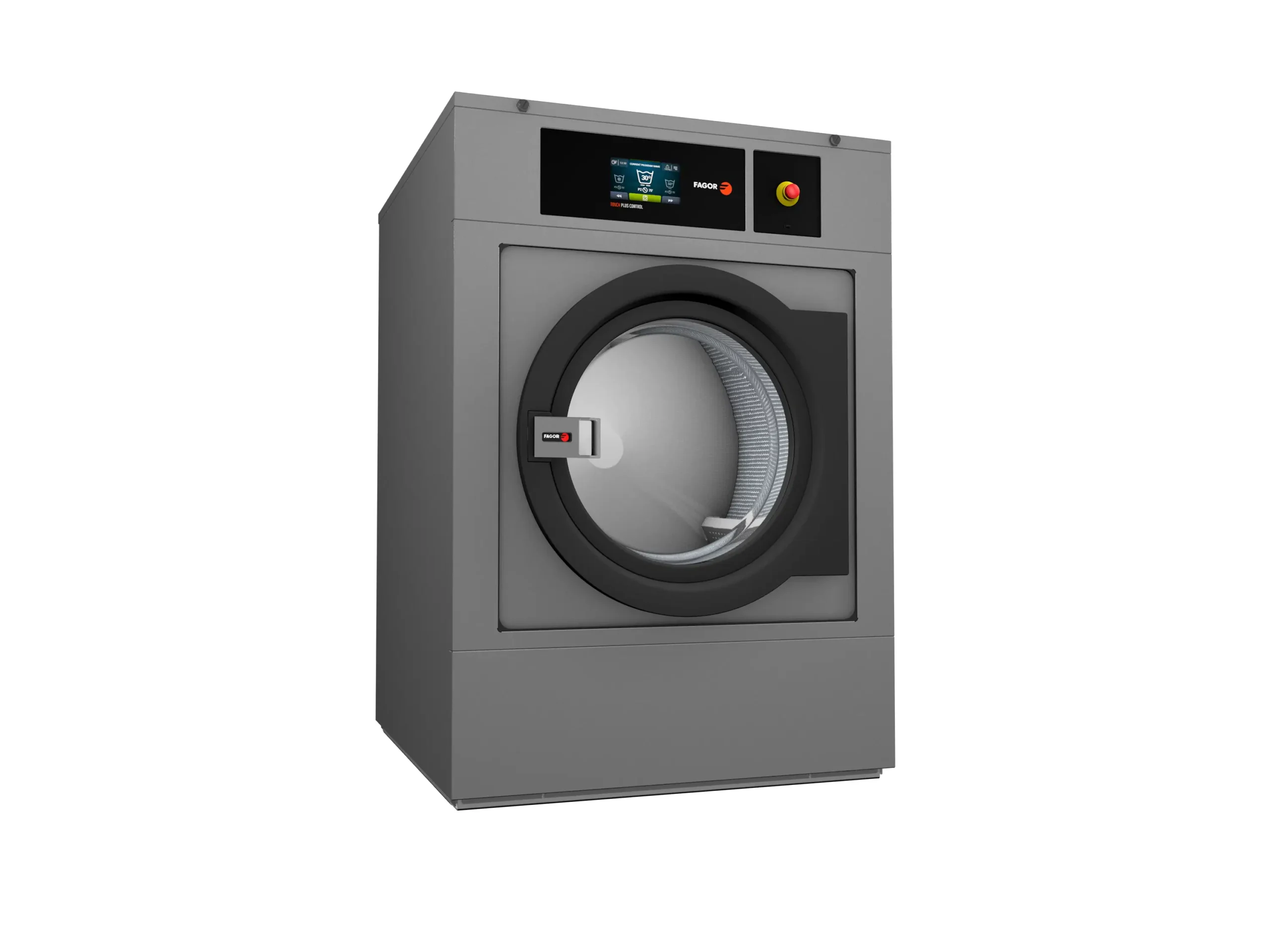
Soft-mount washers use suspension systems, shock absorbers, balance controls, and variable-frequency drives to reduce vibration transferred to the building. This design supports significantly higher extraction speeds in many models.
Soft-mount equipment is often beneficial when:
- The laundry is located on an upper floor
- The building has limited foundation options
- Construction downtime must be minimized
- The facility needs maximum extraction performance
- Drying capacity is a major bottleneck
- The laundry must support high daily throughput
Wash IQ’s soft-mount washer options include high-extraction equipment rated for demanding commercial applications. Soft-mount machines can cost more initially, but they may reduce installation costs and produce greater savings during daily operation.
When Standard Washers Still Make Sense
High extraction is not automatically the correct choice for every OPL operation.
Standard or lower-extraction washers may be appropriate when:
The facility has modest daily volume
A small hotel, boutique property, restaurant, or limited-service facility may not process enough linen to justify the additional capital cost of high-extraction equipment.
The laundry has a lower initial budget
When capital funding is limited, a standard washer may allow the facility to replace failing equipment without delaying the project. The decision should still include a long-term utility and labor analysis.
The loads contain lighter soil
Facilities processing lightly soiled uniforms, linens, or general-use textiles may not require the same extraction and cycle flexibility as hospitals, large hotels, or industrial laundries.
The dryer is not a bottleneck
If the facility has excess dryer capacity and low utility costs, the return on a high-extraction washer may be slower.
Existing infrastructure favors hard-mount equipment
A suitable reinforced slab can make hard-mount installation simpler and more economical. The facility should confirm that the foundation, anchoring, drainage, and utilities meet the equipment requirements.
Standard equipment remains a valid option when it aligns with actual production needs. The objective is not to purchase the most advanced machine available. The objective is to select the equipment that delivers the best operational result.
Total Cost of Ownership: The Complete Comparison
A proper comparison must include more than washer price.
Utility cost
Estimate water, heating, gas, electricity, and steam consumption. High extraction can reduce dryer runtime and lower the energy required to finish each load.
Labor cost
Faster cycles can reduce operator waiting time, overtime, manual handling, and production delays. Labor savings are especially important in facilities operating multiple shifts.
Linen life
Excessive heat and prolonged tumbling can accelerate fabric wear, linting, shrinkage, and fiber damage. By reducing the amount of water that must be evaporated, high extraction may reduce thermal stress on linen.
However, extraction programs should still match the textile. Delicate or specialty fabrics may require lower speeds to protect product quality.
Maintenance and service
A high-extraction washer has sophisticated balance controls, suspension components, and drive systems. Preventive maintenance is essential. The facility should evaluate parts availability, service response time, technician expertise, and the supplier’s ability to provide Expert repair for all major equipment brands.
Chemical and water control
Load sensing, programmable water levels, and accurate dosing can reduce unnecessary water and chemical use. Wash IQ also provides chemical optimization support to help facilities control chemical costs while maintaining cleaning and hygiene standards.

How to Evaluate Your Facility Before Buying
Before selecting high-extraction or standard equipment, document the following:
- Pounds of linen processed per day and during peak periods
- Textile categories, including towels, sheets, uniforms, and healthcare goods
- Current washer and dryer cycle times
- Dryer fuel type and average utility cost
- Labor hours spent loading, unloading, and waiting
- Available floor space and building location
- Foundation, drainage, electrical, gas, and steam requirements
- Required linen turnaround time
- Current rewash rate and linen replacement costs
- Maintenance history and recurring equipment failures
Then calculate the expected cost per processed pound. Include washer purchase, installation, utilities, labor, maintenance, chemical usage, and linen replacement.
For high-volume hotels, hospitals, banquet operations, and commercial laundries, a soft-mount high-extraction washer will often provide the strongest total cost of ownership. For smaller OPL operations, a standard or hard-mount washer may remain the more practical investment.
The Bottom Line
High-extraction washers generally provide lower moisture retention, shorter drying times, improved throughput, and lower downstream utility costs. Soft-mount designs also offer valuable flexibility when foundation work or upper-floor installation is a concern.
Standard washers still make sense for smaller OPL operations, lighter soil loads, constrained budgets, and facilities with sufficient dryer capacity.
The correct choice requires a complete operational review. Compare G-force, residual moisture, capacity, cycle time, installation requirements, utility costs, labor, linen life, and service support before making a purchase.
Wash IQ provides a complete range of industrial laundry equipment, including commercial washers and dryers, facility design support, efficiency reports, chemical optimization, and Expert repair services. With a 3-year parts and labor warranty and more than 50 years of industry expertise, Wash IQ can help your facility develop a reliable, cost-effective laundry plan for one location or multiple sites.