How Chemical Optimization Can Slash Your Laundry Costs by 30%
In today’s competitive market, facility managers and business owners are under constant pressure to enhance operational efficiency while simultaneously reducing overhead. In the world of industrial laundry, where utility rates and labor costs continue to climb, identifying hidden avenues for savings is not merely beneficial: it is essential for long-term viability. While many focus on machine maintenance or labor scheduling, one of the most significant levers for cost control remains largely misunderstood: chemical optimization.
Chemical optimization is the strategic alignment of chemistry, equipment, and wash processes to achieve maximum cleaning results with minimum resources. It is not simply about buying cheaper detergents; it is a technical discipline that, when executed correctly, can slash total laundry operating costs by approximately 30%. At Wash IQ, we have seen how a precise, science-based approach to laundry chemicals transforms a facility from a cost center into a model of industrial efficiency.
The Invisible Drain on Profitability
Many commercial laundry operations suffer from "chemical drift": a gradual shift away from optimal dosing due to manual intervention, hardware malfunctions, or incorrect water chemistry. This drift manifests in two primary ways, both of which are financially damaging.
First, overdosing leads to direct waste of expensive chemicals. When a facility uses 20% more detergent than necessary, it is effectively flushing capital down the drain. Furthermore, excessive chemical concentrations require more rinse cycles, which increases water consumption and sewer costs.
Second, under-dosing is equally costly. Insufficient chemistry leads to "rewashes," where linens must be processed a second time to meet hygiene standards. A rewash consumes twice the labor, twice the utilities, and twice the machine time of a successful first-pass wash. By implementing a rigorous chemical optimization program, facilities can achieve a one-pass performance rate that drastically lowers the cost per pound of processed linen.

The Science of Precision: Titration and Water Quality
To achieve a 30% reduction in costs, one must move beyond guesswork. The foundation of any optimization effort is an understanding of water quality. Factors such as pH balance and water hardness have a profound impact on chemical efficacy.
In many regions, hard water in a commercial laundry can neutralize active cleaning agents, forcing the system to compensate with higher chemical doses. By analyzing the mineral content of your water supply, we can calibrate the chemistry to work with your water rather than against it. This often involves performing titration tests: a scientific method used to determine the exact concentration of a chemical in a solution.
When our technicians perform an Efficiency Report, we measure the alkalinity and surfactant levels at every stage of the wash cycle. This ensures that the pH is high enough to remove heavy soils but properly neutralized during the final rinse to prevent "chemical burn" on fabrics. This level of technical precision is vital for maintaining the integrity of high-value linens.

Automated Dosing: The Core of Industrial Efficiency
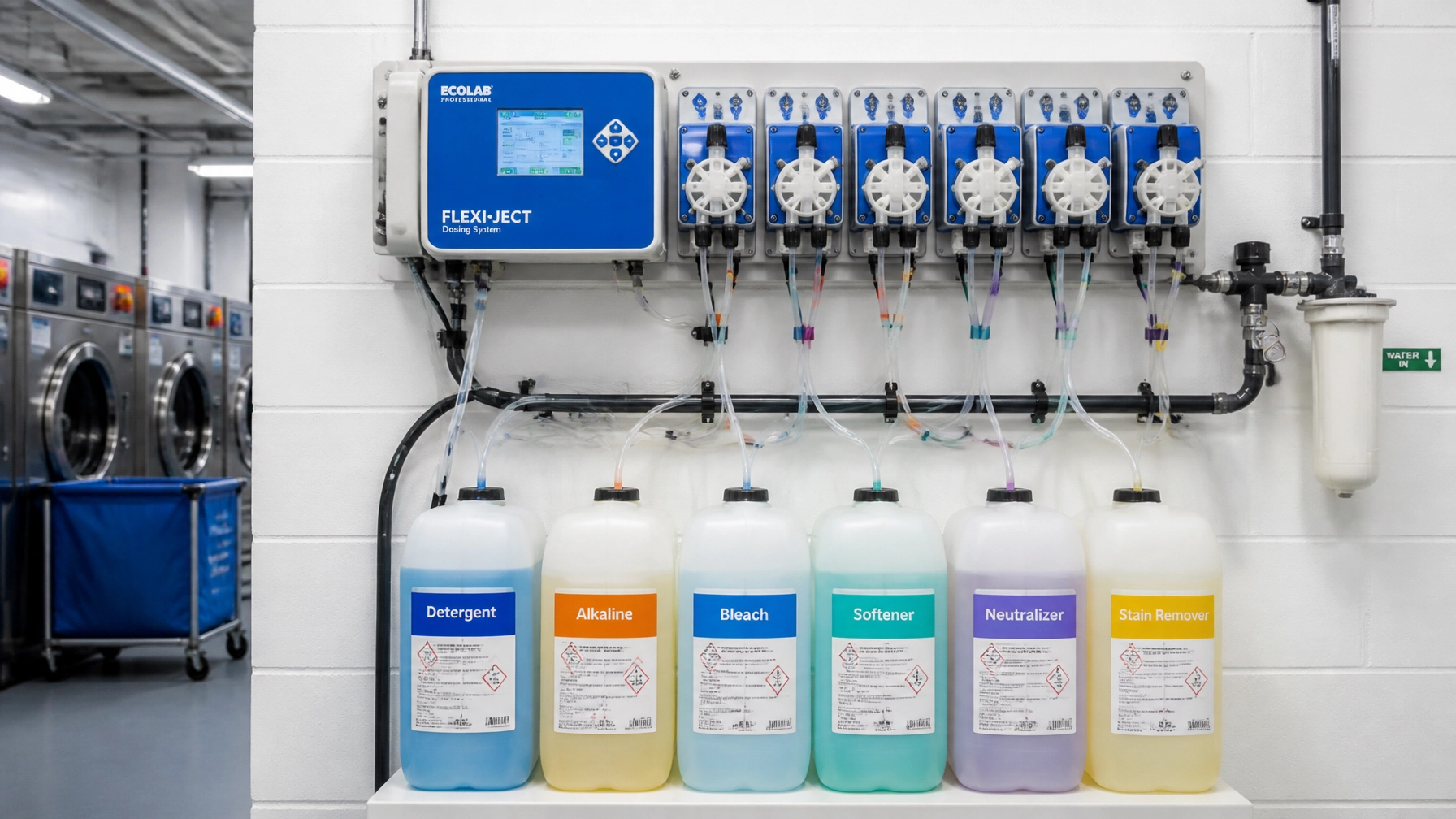
The most effective way to maintain these precise standards is through automated dosing systems. Manual pouring is a relic of the past that introduces too much variability and risk. Modern industrial laundry equipment, such as the BC HE Series, is designed to integrate seamlessly with automated chemical pumps.
These systems deliver the exact milliliter of detergent, bleach, or softener at the precise second it is needed in the cycle. This level of automation provides several critical benefits:
- Consistency: Every load is treated identical to the last, ensuring uniform quality.
- Labor Savings: Staff no longer need to measure or handle concentrated chemicals, reducing the risk of workplace injuries and allowing them to focus on throughput.
- Real-Time Data: Advanced dispensers provide usage reports, allowing management to track chemical spend against poundage in real-time.
By removing the human element from chemical measurement, a facility can ensure that every drop of product is used for its intended purpose, eliminating the 15–25% waste commonly associated with manual dosing.

Slashing Utility and Energy Consumption
While the direct savings on chemical purchases are substantial, the largest portion of the 30% cost reduction often comes from utilities. Modern, optimized chemistry is formulated to work at significantly lower temperatures.
Historically, industrial laundry required water temperatures of 160°F or higher to activate detergents. Today, high-performance cold-water enzymes can achieve the same: or better: results at 60–80°F. Since heating water is one of the largest expenses in a laundry facility, transitioning to cold-water optimization can reduce water-heating energy costs by as much as 70–90%.
Furthermore, optimized rinsing processes use less water. By using conductivity sensors that stop the rinse cycle as soon as all chemicals are cleared, facilities can reduce water and sewer usage by 15–30%. When combined with high-speed extraction that removes more moisture before the drying phase, the total cycle time is reduced, further lowering the energy demand on commercial dryers.
Extending Linen Longevity: The Hidden ROI
One of the most overlooked costs in any hotel or hospital is linen replacement. Chemicals are inherently aggressive; if they are not balanced correctly, they weaken the fibers of towels, sheets, and gowns. Over-bleaching or improper pH neutralization leads to premature fraying, graying, and tearing.
Chemical optimization focuses on fabric care as much as soil removal. By maintaining the correct pH and using milder, more targeted surfactants, you can extend the life of your linens by 20% or more. For a high-volume hotel, this can translate into tens of thousands of dollars in annual savings that go straight to the bottom line.
A well-optimized system ensures that linens remain soft, bright, and strong for their maximum possible lifespan, reducing the capital expenditure required for inventory replacement.

Implementing a Strategic Solution
Achieving these results requires a partner with deep industry expertise. At Wash IQ, we bring over 50 years of experience to every facility we service. We do not just provide equipment; we provide comprehensive OPL (On-Premise Laundry) solutions that encompass every aspect of the operation.
Our process begins with a thorough audit of your current operations. We analyze your machine settings, water chemistry, and chemical usage to identify exactly where the waste is occurring. We then install the latest in automated dosing technology and calibrate your wash formulas for peak performance.
In an industry where margins are tight and operational excellence is the standard, chemical optimization is no longer optional. It is a crucial strategy for any facility manager who is serious about reducing costs without sacrificing quality. By aligning your chemistry with your equipment, you can realize a 30% reduction in total costs, ensuring your facility remains competitive and efficient for years to come.