The Science Behind Chemical Optimization: What Actually Works in 2026
In today’s competitive market, the difference between a profitable laundry operation and one burdened by overhead often lies in the invisible variables of chemical management. In the world of industrial-grade laundry, chemical optimization is no longer a matter of simple detergent selection; it is a rigorous discipline involving automated dosing, IoT-driven analytics, and advanced molecular chemistry. For facility managers in hospitality, healthcare, and commercial sectors, understanding the science behind these systems is essential for ensuring operational excellence and textile longevity.
As we progress through 2026, the industry has shifted from manual estimation to a data-centric model where every milliliter of chemical is accounted for and every wash cycle is a calculated reaction. At Wash IQ, we recognize that efficiency is not merely an aspiration but a vital requirement for modern business success. This article explores the scientific standards and technological advancements that define chemical optimization today.
The Foundation: Automated Dosing and IoT Integration
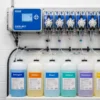
The most significant advancement in 2026 is the widespread adoption of automated dosing systems, which now account for over 50% of the technology used in commercial and hospitality laundry facilities. These systems eliminate human error: the single most common cause of chemical waste and fabric damage.
Automated dosing units are now frequently integrated with Internet of Things (IoT) sensors that monitor wash performance in real-time. These sensors track chemical concentration, water pH, and temperature, transmitting data directly to centralized dashboards. This connectivity allows facility managers to identify deviations immediately, ensuring that every load receives the precise chemical profile required for its specific soil level and fabric type.

Key Benefits of IoT-Connected Systems:
- Predictive Replenishment: Systems notify suppliers or facility staff when chemical levels are low, preventing downtime.
- Performance Benchmarking: Managers can compare chemical costs per kilogram of linen across multiple sites.
- Precision Control: Adjustments can be made remotely to account for changes in water hardness or seasonal soil variations.
The Chemistry of 2026: Enzymes and Low-Temperature Performance
The "science" of laundry has evolved at the molecular level. Modern formulations have moved away from high-alkaline, high-heat traditional detergents in favor of enzyme-rich, biotechnology-based solutions. Enzymes such as protease, amylase, and lipase are engineered to break down specific protein and fat stains at much lower temperatures than previously possible.
The impact of this shift is twofold. First, washing at lower temperatures significantly reduces utility costs: often by as much as 40%: while decreasing the carbon footprint of the facility. Second, low-temperature washing is far less abrasive to textile fibers. By reducing thermal shock and chemical degradation, facilities can extend the life of their linens by 20% or more, which is a crucial factor in the ROI of hospitality and healthcare operations.
Scientific Process Control: The Role of Titration
While digital sensors are highly accurate, professional chemical optimization still relies on the fundamental science of titration. Titration is the laboratory process of determining the concentration of a dissolved substance by adding a reagent of known strength. In an industrial laundry context, this is a vital quality control step.
Why Titration Remains Essential:
- Alkalinity and pH Balance: Precise titration ensures that builders and alkalis are at high enough levels to remove heavy soils without leaving residues that can irritate skin or damage fibers.
- Bleach Concentration: Redox titration verifies that oxidizers (like chlorine or peroxide) are strong enough to sanitize but not so aggressive that they cause premature linen wear.
- Neutralizer Verification: This step confirms that souring agents have effectively returned the textiles to a neutral pH, which is critical for compliance in healthcare settings.

At Wash IQ, our Efficiency Reports often include these deep-dive technical analyses to ensure that the hardware settings match the chemical reality of the water and soil conditions.
Balancing the Sinner’s Circle
To understand optimization, one must understand the "Sinner’s Circle," a foundational concept in laundry science. This principle states that a successful wash is determined by four variables:
- Chemical Action: The strength and type of detergents used.
- Mechanical Action: The agitation and drum movement of the machine.
- Temperature: The heat applied to the cycle.
- Time: The duration of each phase.
Optimization is the art of balancing these factors. For instance, if you reduce the temperature to save on energy, you must compensate by increasing the chemical action (via enzymes) or the mechanical action. In 2026, the trend is to maximize chemical sophistication (enzymes) to minimize temperature and time, thereby protecting the equipment and the textiles.

Chemical Cost Optimization: A Strategic Imperative
For a facility manager, chemical optimization is not just a scientific pursuit; it is a financial strategy. Chemical costs typically represent a significant portion of the total operating budget. By implementing a managed chemical program: one that bundles high-quality concentrated liquids with precision dosing hardware: businesses can achieve a higher level of predictability in their expenses.
Concentrated liquid formulations are preferred in 2026 because they dissolve instantly and are easily metered by automated pumps. Furthermore, moving toward 2X or 3X concentrated products reduces the storage footprint and the labor required for container changeovers, further streamlining the facility's workflow.
The Wash IQ Approach to Operational Excellence
Achieving the perfect balance of chemistry and mechanics requires expert oversight. With over 50 years of industry experience, Wash IQ provides a comprehensive suite of services designed to address every aspect of the laundry cycle. From supplying high-quality industrial laundry equipment to providing expert repair and maintenance, our goal is to be a one-stop shop for facility managers.
Our chemical cost optimization services are built on the principles of transparency and technical precision. We don’t just provide the chemicals; we provide the systems and the data analysis needed to ensure those chemicals are working as efficiently as possible.
Conclusion
The science behind chemical optimization in 2026 is a blend of advanced biotechnology, IoT connectivity, and traditional analytical chemistry. By embracing these advancements, industrial laundry facilities can achieve unprecedented levels of efficiency, reduce their environmental impact, and protect their most valuable assets: their equipment and their linens.
In an industry where margins are tight and expectations are high, the move toward scientific optimization is no longer optional. It is the standard for those who lead the market. If you are ready to evaluate the efficiency of your current laundry operation, consider partnering with an expert who understands the technical nuances of the modern wash cycle.
For more information on how we can assist with your equipment and chemical needs, visit Wash IQ.