
How to Reduce Labor Costs With Smarter OPL Laundry Solutions
In today’s competitive market, the operational efficiency of a facility's laundry department is no longer a peripheral concern; it is a vital component of the bottom line. For hotels, hospitals, and assisted living facilities, on-premise laundry (OPL) often represents one of the most significant recurring expenses, with labor costs typically accounting for over 50% of the total budget. Managing these costs requires more than just oversight: it demands a strategic integration of advanced industrial laundry equipment, optimized workflows, and data-driven management.
Reducing labor expenditures does not necessarily imply a reduction in staff. Rather, it focuses on increasing the "pounds per operator hour" (PPOH) by eliminating bottlenecks, reducing manual intervention, and leveraging smarter technology. By adopting a comprehensive approach to OPL management, facility managers can achieve exceptional results that balance high-quality output with fiscal responsibility.
The Foundation: Quantifying Labor Waste
Before implementing structural changes, it is essential to establish a baseline through rigorous analysis. Many facilities operate under the assumption that their labor allocation is efficient, only to find that significant hours are lost to machine downtime, waiting for cycles to finish, or performing unnecessary re-washes.
Wash IQ provides detailed Efficiency Reports that analyze these specific variables. By measuring the labor hours dedicated to each task: sorting, loading, transferring, and folding: facility managers can pinpoint exactly where the process slows down. Often, the culprit is not the speed of the staff, but the limitations of the equipment they are forced to use.
High-Performance Equipment as a Labor Lever
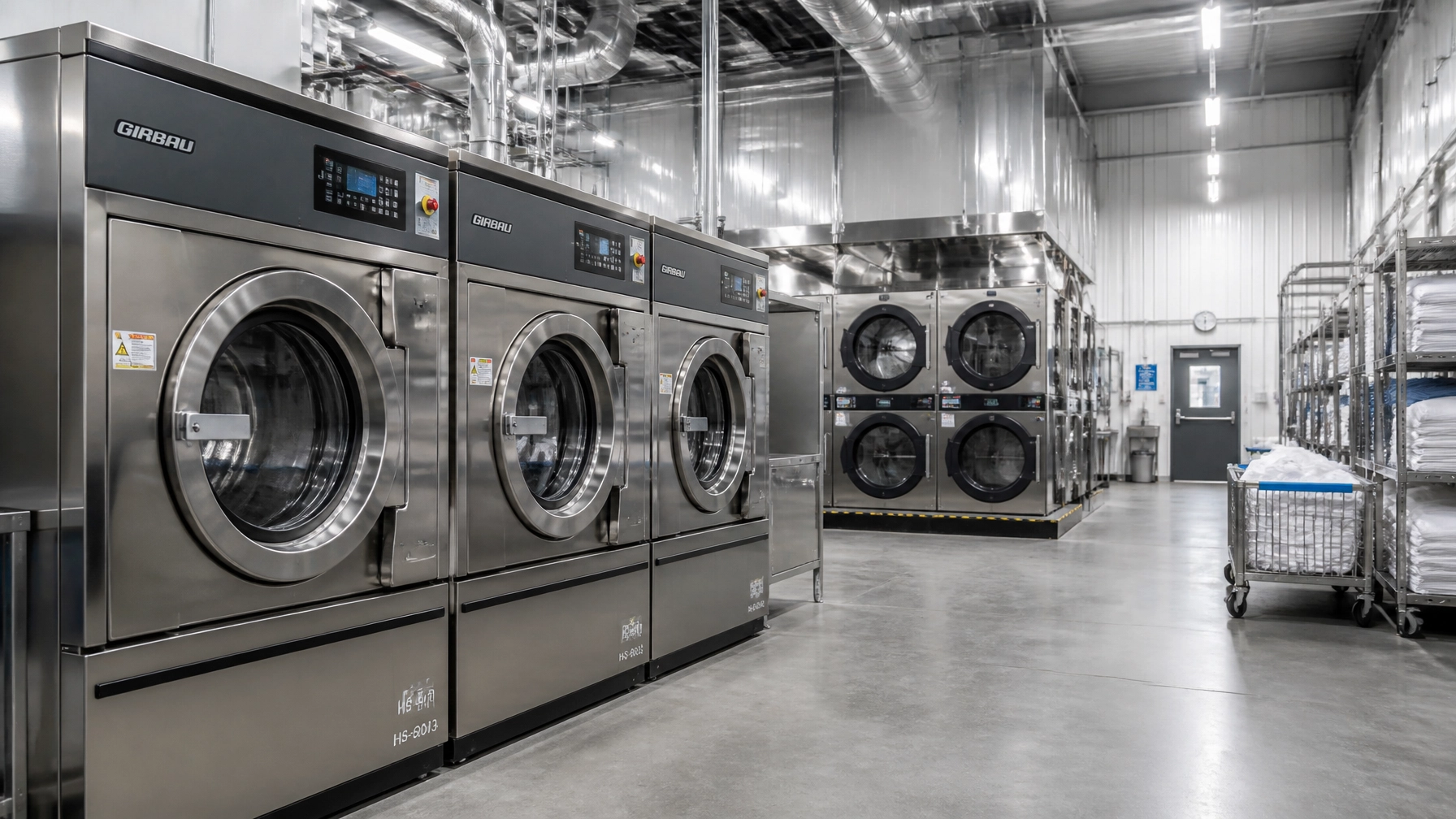
The most direct method to reduce labor costs is to invest in industrial laundry equipment engineered for high throughput. Modern machines are designed to do more of the "heavy lifting," allowing staff to focus on higher-value tasks.
High-Extract Washer-Extractors
The transition between washing and drying is a critical bottleneck. Traditional washers may leave a significant amount of moisture in the textiles, leading to extended drying times. High-speed, high-extract washer-extractors are crucial in this regard. These machines utilize high G-force extraction to remove a greater percentage of water during the final spin cycle. By reducing the moisture content of the load before it enters the dryer, the drying time is slashed, which in turn reduces the labor hours spent waiting for loads to finish and transferring linens.

Programmable Digital Controls
Human error is a frequent driver of unnecessary labor. When staff must manually select temperatures, water levels, and chemical dosages, the risk of "re-wash" increases. Integrated digital controls allow for the programming of specific formulas for different linen types: such as towels, bedsheets, or surgical scrubs. This consistency ensures that the load is cleaned correctly the first time, eliminating the labor cost associated with processing the same linen twice.
Moisture Sensing and Intelligent Drying
Over-drying is a common yet often overlooked inefficiency in OPL environments. It not only wastes significant amounts of energy but also degrades fabric quality and keeps machines (and staff) occupied longer than necessary.

Advanced drying solutions, such as the BC HE-Series, utilize moisture-sensing technology to automatically terminate the cycle the moment the linens reach the desired dryness level. This prevents staff from "babysitting" the dryers and ensures that the equipment is immediately available for the next load, significantly improving the facility’s overall throughput per shift.
Chemical Optimization: The Silent Efficiency Driver
The relationship between chemical usage and labor efficiency is profound. Incorrect chemical concentrations can lead to stains that require manual spotting or entire loads that must be re-laundered. Furthermore, manual chemical handling is a tedious task that consumes valuable staff time and presents safety risks.

Implementing an automatic chemical dispensing system is a vital step toward labor reduction. These systems ensure the exact amount of detergent, destainer, and softener is delivered at the precise moment in the wash cycle. When combined with Chemical Cost Optimization services, facilities can reduce the re-wash rate to nearly zero. Additionally, addressing issues such as hard water can further enhance chemical performance, ensuring that textiles come out clean and soft with minimal manual intervention.
Layout and Workflow Engineering
A facility’s physical layout can either facilitate or frustrate labor efficiency. In many older laundry rooms, staff are forced to take unnecessary steps or maneuver carts through narrow corridors, leading to "wasted motion."
At Wash IQ, our Design Services focus on creating a linear, one-way flow for linens: from the dirty sorting area, through the washers and dryers, to the folding stations and storage. By minimizing the travel distance for both staff and textiles, a well-designed layout reduces physical strain and speeds up the entire process.
For high-volume facilities, the addition of automated finishing equipment, such as industrial flatwork ironers, can further revolutionize labor productivity. These machines can process large volumes of linens with a fraction of the manual labor required for hand-folding and pressing.

The Importance of Preventative Maintenance
Even the most advanced OPL solution will fail to save on labor if the equipment is frequently out of service. Equipment downtime forces staff to work overtime to catch up or, in extreme cases, requires the facility to outsource laundry at a premium rate.
Reliability is essential. Wash IQ’s commitment to providing a 3-year parts and labor warranty, backed by over 50 years of expertise in Repair and Maintenance Services, ensures that your operation remains functional. Regular expert maintenance prevents the catastrophic failures that lead to emergency labor costs and operational chaos.
Conclusion: A Strategic Partnership for Operational Excellence
Reducing labor costs in an OPL environment is not a one-time fix; it is a continuous pursuit of operational excellence. By integrating high-capacity industrial laundry equipment with automated chemical systems, smart digital controls, and an optimized facility layout, business owners can significantly lower their overhead while maintaining the highest standards of cleanliness.
In the world of industrial laundry, time is quite literally money. Investing in the right technology and the right partner is the most effective way to ensure that your laundry department remains an asset to your facility’s success rather than a drain on its resources.