The True Lifespan of Commercial Laundry Equipment (And When to Replace)
In today’s competitive market, the operational efficiency of an industrial laundry facility is not merely a matter of convenience; it is a vital component of business sustainability. For facility managers in hotels, hospitals, and commercial laundries, the equipment on the floor represents a significant capital investment. Understanding the true lifespan of this machinery: and identifying the precise moment when maintenance costs begin to outweigh the benefits of replacement: is crucial for maintaining a profitable operation.
At Wash IQ, we have spent over 50 years assisting businesses in navigating these high-stakes decisions. Whether you are managing a single boutique location or a large-scale multi-site operation, the longevity of your hardware dictates your long-term overhead. In this guide, we examine the realistic life expectancy of industrial laundry equipment and the operational signals that indicate a replacement is overdue.
The Standard Lifespan of Industrial Equipment
The lifespan of commercial laundry equipment is primarily dictated by its build quality and the intensity of its duty cycle. While "light commercial" units may struggle to reach a decade, true industrial-grade machinery is engineered for a much longer service life.
Industrial Washers and Extractors
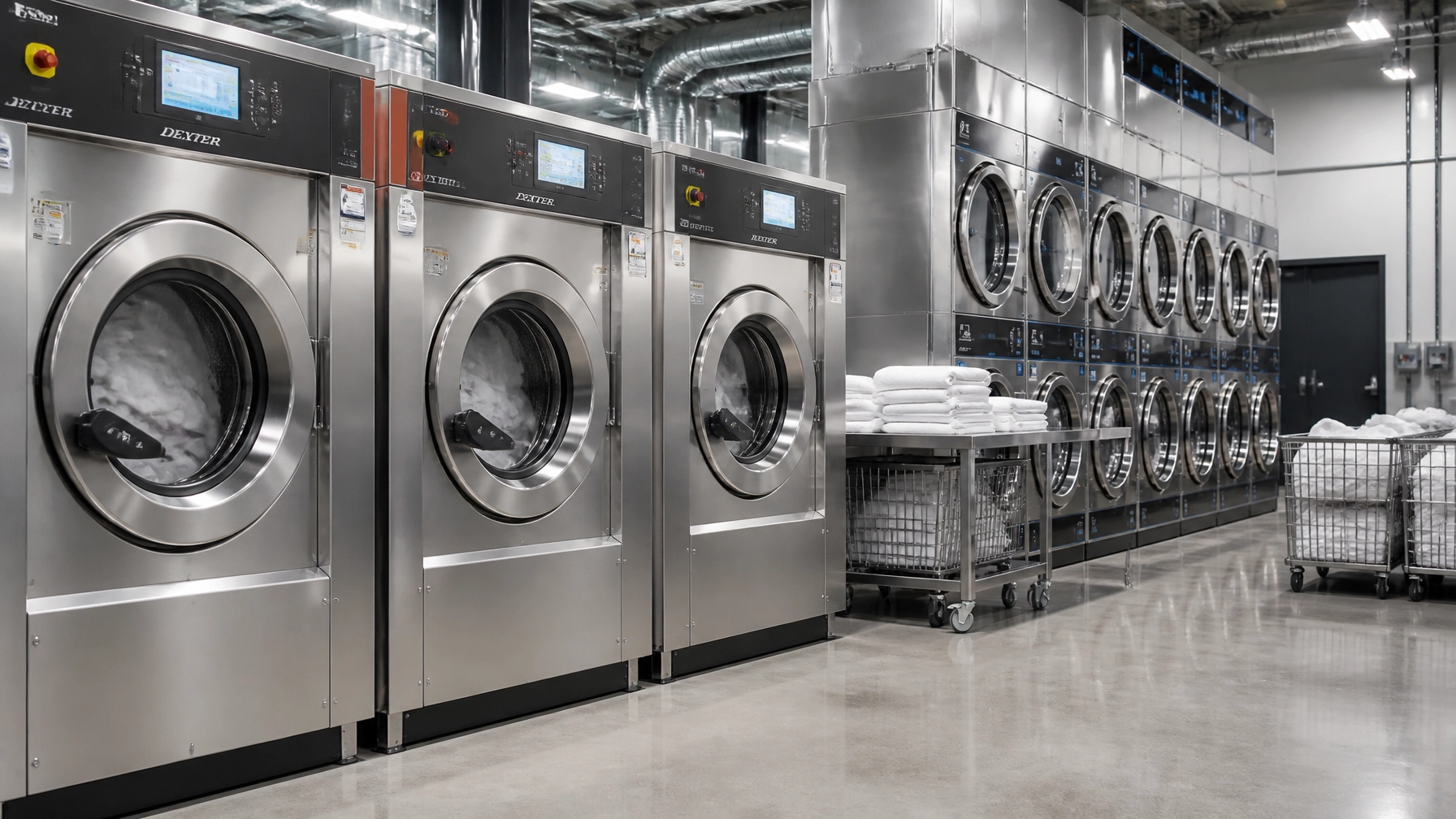
Most high-capacity industrial washers are designed to operate for 10 to 15 years under standard commercial conditions. Front-loading industrial units, which are often the workhorses of On-Premise Laundry (OPL) facilities, generally offer a more robust architecture than top-loading counterparts, often reaching the 15-year mark with consistent care.
However, premium brands: such as those we supply at Wash IQ: can frequently exceed these averages. It is not uncommon for heavy-duty industrial units to remain operational for 20 to 30 years when supported by a rigorous preventive maintenance schedule and expert repair services.

Commercial Tumble Dryers
Dryers typically mirror the lifespan of washers, averaging 10 to 15 years. Because they involve fewer complex mechanical movements than an extractor, their primary points of failure are often related to heating elements, airflow obstructions, and drum rollers. In facilities where space is a premium, stack dryers are an essential solution, providing high throughput while maintaining the same 15-year expectation for mechanical reliability.

Finishing Equipment: Ironers and Folders
Finishing equipment, including flatwork ironers and automated folders, often boasts the longest mechanical life in the facility, frequently reaching 15 to 20 years. However, their "economic life" is often shorter. As control systems become obsolete and energy-efficient technologies evolve, many facilities find that replacing an ironer after 12 years provides a higher ROI than continuing to maintain a mechanically sound but technologically outdated unit.

Factors That Influence Longevity
The "average" lifespan is a baseline, but several environmental and operational factors can either extend or drastically shorten the life of your machines.
- Usage Intensity: A facility operating three shifts 24/7 will naturally reach the end of its equipment's life three times faster than a boutique hotel operating a single daily shift.
- Water Quality: High mineral content (hard water) leads to scale buildup on heating elements and within internal valves. This forces the machine to work harder, accelerating wear and increasing utility consumption.
- Chemical Balance: Incorrect chemical concentrations can be corrosive to stainless steel drums and rubber seals. Chemical cost optimization is not just about saving money on detergents; it is a vital strategy for protecting your hardware from premature degradation.
- Maintenance Consistency: Proactive maintenance is typically 5 to 10 times more cost-effective than reactive, emergency repairs. Ignoring small vibrations or minor leaks often leads to catastrophic failures in core components like drum bearings.
The Strategic Threshold: When to Repair vs. Replace
One of the most important decisions a facility manager face is determining when a machine has reached its "tipping point." Continuing to repair an aging machine can become a "sunk cost" fallacy that drains your annual budget.
The 50% Rule
A standard industry benchmark is the 50% rule: if a single repair estimate exceeds 50% of the cost of a new, more efficient machine, replacement is almost always the superior choice. This is especially true if the equipment is over 10 years old.
Frequent Downtime
In the world of industrial laundry, downtime is the ultimate enemy. If a machine is frequently marked "Out of Order," the cost is not just the repair bill: it is the lost labor productivity and the potential delay in room turnovers or patient care. When reliability becomes a variable rather than a constant, replacement becomes essential.
Rising Utility and Chemical Costs
Older machines are significantly less efficient than modern units. A washer from 2010 uses considerably more water and energy than a 2026 model. Furthermore, modern machines feature advanced programmable controls that allow for precise chemical injection, reducing waste. If your utility bills are rising despite steady volume, your equipment may be the culprit.
The Value of Efficiency Reports
To take the guesswork out of these decisions, Wash IQ provides comprehensive Efficiency Reports. We analyze your current operations to identify exactly where you are losing money: whether through excessive water usage, high chemical waste, or frequent repair cycles.
Our team of experts, with over 50 years of industry experience, helps you calculate the exact ROI of an upgrade. In many cases, the utility savings from new industrial laundry equipment can pay for the machine's financing in just a few years.

Conclusion: Planning for the Future
The lifespan of your commercial laundry equipment is not set in stone. It is a manageable variable that depends on the quality of your equipment, the precision of your chemical usage, and the consistency of your maintenance.
By understanding the typical 10-to-15-year lifecycle and monitoring for the warning signs of mechanical obsolescence, you can transition from a reactive "break-fix" mindset to a proactive operational strategy. Whether you require a single repair or a complete facility redesign, Wash IQ is your one-stop shop for ensuring your laundry operation remains a model of efficiency and reliability.
Don't wait for a catastrophic failure to plan your next move. Contact Wash IQ today for an efficiency audit and ensure your facility is equipped for the decade ahead.