Industrial Laundry Operational Excellence: Maximizing Efficiency and Equipment Lifespan
In today’s competitive market, facility managers must treat laundry performance as a measurable business function rather than a routine support activity. Hotels, hospitals, banquet facilities, and commercial laundry plants depend on consistent linen availability, reliable hygiene, and predictable operating costs. Delays, rewash cycles, excessive utility consumption, and unplanned equipment failures can affect service quality and financial performance simultaneously.
Operational excellence requires an integrated strategy. The most effective facilities align industrial laundry equipment, workflow design, wash programming, utility management, chemical control, and preventive maintenance. This approach increases throughput while protecting textile quality and extending the useful life of commercial washers and dryers.
1. Establish a measurable operational baseline
Improvement begins with accurate information. Before changing equipment, formulas, or staffing, document how the laundry operates during normal and peak production periods.
Facility managers should track:
- Pounds processed per shift and per labor hour
- Washer and dryer utilization
- Average cycle time by textile category
- Rewash and reject rates
- Water, gas, and electricity use per pound
- Chemical consumption per load or pound
- Planned versus unplanned maintenance hours
- Equipment downtime and repair frequency
A practical baseline should distinguish between equipment, shifts, and load types. For example, a high water-use reading may result from an inefficient machine, an incorrect cycle formula, underloading, or a leak. Without machine-level and process-level data, these causes are difficult to separate.
The U.S. Environmental Protection Agency recommends establishing water-use baselines and monitoring commercial laundry equipment through dedicated measurement where practical. Reviewing EPA commercial laundry efficiency guidance can help managers identify conservation opportunities and evaluate improvement projects.
2. Increase throughput through disciplined workflow
Throughput is not determined by machine capacity alone. Facility layout, load preparation, cart movement, and operator practices can either support or restrict production.
A high-performing laundry generally follows a one-direction flow:
Soiled receiving → sorting → weighing → washing → extraction → drying → finishing → folding → clean storage
This arrangement reduces unnecessary handling and helps prevent contact between soiled and processed textiles. It is particularly important in healthcare and senior-care environments, where cross-contamination control is a vital operational responsibility.
Washers and dryers should be positioned according to process sequence. Sorting and weighing areas should be close to washer loading points, while dryers and finishing equipment should be located near the clean side of the wash aisle. Adequate clearance around each machine is essential for safe access, cart movement, inspections, and future repairs.
Wash IQ’s facility design services can help businesses evaluate space utilization, equipment placement, utilities, and future capacity requirements before installing or replacing machines.
Standardize load preparation
Loading errors create hidden costs. Underloaded machines consume nearly the same utilities as full loads, while overloaded machines can produce poor cleaning, excessive mechanical stress, and longer drying times.
Establish written loading standards based on:
- Rated machine capacity
- Textile type and density
- Soil classification
- Moisture content after extraction
- Required drying and finishing method
As a general operating target, many facilities aim to load washers within approximately 80% to 85% of rated capacity, subject to the equipment manufacturer’s instructions and the characteristics of the textiles being processed. Scales, color-coded carts, and posted load guides help operators apply the standard consistently.

3. Control water and energy consumption
Utility costs are influenced by equipment selection, cycle programming, maintenance, and operator behavior. Water heating is especially significant because every unnecessary gallon may also create additional energy, chemical, and wastewater costs.
Optimize wash formulas
Avoid using one formula for every load. Sort textiles by soil level, fabric type, color, and hygiene requirements. Lightly soiled hospitality linens generally should not receive the same treatment as heavily soiled workwear or healthcare textiles.
Review each formula for:
- Water levels and bath count
- Fill and drain efficiency
- Wash and rinse duration
- Temperature requirements
- Extraction speed and duration
- Chemical injection points
- Rewash frequency
Hot-water cycles should be reserved for loads that require them for soil removal or validated hygiene procedures. Where quality and sanitation requirements permit, lower-temperature programs can reduce water-heating demand.
Drying efficiency begins during extraction. Higher extraction performance removes more moisture before the load reaches the dryer, reducing drying time and energy use. However, extraction settings must be matched to fabric construction. Excessive mechanical action can increase wrinkling, damage delicate textiles, or create finishing problems.
Dryers should use appropriate temperature settings and, where available, moisture-sensing controls. Overdrying wastes energy and accelerates fiber degradation. A dryer that consistently runs longer than expected should be investigated rather than accepted as normal.
4. Apply chemical optimization without compromising hygiene
Chemical optimization is not simply a matter of purchasing lower-cost products. It is the controlled alignment of chemistry, water conditions, soil types, load weights, temperature, and cycle design.
Overdosing can create residue, increase rinse requirements, damage textiles, and contribute to skin irritation for guests, patients, or employees. Underdosing can result in poor soil removal and expensive rewash cycles. Both conditions reduce operational efficiency.
A formal chemical optimization program should include:
- Water analysis: Test hardness, alkalinity, pH, and other conditions that affect cleaning performance.
- Load classification: Match formulas to textile type and soil level.
- Automated dispensing: Use calibrated pumps or controlled dispensing systems rather than inconsistent manual dosing.
- Routine calibration: Verify chemical volume at scheduled intervals and after service work.
- Usage reporting: Monitor chemical consumption per pound and compare it with rewash and quality data.
- Formula control: Restrict unauthorized changes to programmed cycles and dosing parameters.
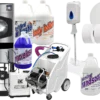
Wash IQ’s commercial-grade laundry detergent is described for institutional and commercial laundry requirements, including light-to-medium soil loads. Product selection should always be evaluated alongside the facility’s water chemistry, textile mix, equipment, and documented process requirements.
Wash IQ also provides chemical cost optimization support to help businesses review dosing practices and reduce unnecessary chemical expense while maintaining product quality.

5. Maintain commercial washers and dryers proactively
Preventive maintenance is essential for uptime, safety, and equipment lifespan. A reactive approach often allows minor faults to develop into major failures that affect production schedules and repair budgets.
Daily operator checks
Operators should complete documented checks at the start or end of each shift:
- Inspect hoses, door seals, valves, and visible connections for leaks
- Confirm that washer doors and safety interlocks operate correctly
- Clean detergent compartments and remove residue
- Check dryer lint screens between uses
- Inspect dryer airflow and report unusual heat or cycle times
- Clean machine surfaces and the surrounding floor
- Report abnormal noise, vibration, odor, or water accumulation
Washer doors should remain open between cycles when permitted by the equipment design. Ventilating the wash chamber helps reduce moisture accumulation, odor, and microbial growth.
Weekly and monthly maintenance
Maintenance personnel should inspect belts, pulleys, bearings, drain systems, inlet screens, exhaust paths, and electrical connections according to the equipment service manual. Dryer exhaust restrictions are especially important because poor airflow increases energy use, extends cycle times, and creates a serious fire hazard.
Monthly reviews should include:
- Verification of water and gas pressures
- Inspection of drain flow and valve operation
- Chemical pump calibration
- Examination of vibration and machine leveling
- Review of error codes and recurring service calls
- Inspection of burner, heating, or steam components where applicable
- Confirmation that emergency stops and safety devices function correctly
Maintenance records should identify the asset, symptom, root cause, parts used, labor time, and production impact. This information supports replacement planning and reveals recurring failures before they become chronic.

6. Know when to escalate to Expert repair
Operators should handle routine cleaning, visual checks, and approved basic adjustments. Mechanical, electrical, gas, steam, and control-system faults require qualified service personnel.
Call for Expert repair when you observe:
- Repeated error codes
- Excessive vibration or movement
- Bearing or motor noise
- Inconsistent water levels or drainage
- Electrical trips or control failures
- Gas odors or burner instability
- Persistent leaks
- Unusual dryer temperatures
- Significant changes in cycle time
- Repeated rewash linked to equipment performance
Fast intervention prevents secondary damage. For example, a leaking seal can damage bearings and surrounding components, while restricted dryer airflow can overheat heating elements and increase fire risk.
Wash IQ provides repair and maintenance service for all brands of laundry equipment. Its industrial laundry support is designed for both single-location businesses and multi-site operations requiring consistent service standards.
7. Use efficiency reviews to sustain improvement
Operational excellence is a continuous management process. Conduct monthly reviews that compare current performance with the established baseline.
A useful review should ask:
- Did pounds processed increase without a proportional rise in labor?
- Did water, energy, or chemical cost per pound decline?
- Are rewash rates improving?
- Which machines experienced the most downtime?
- Were preventive maintenance tasks completed on schedule?
- Are operators following loading and formula standards?
- Do current capacity and workflow support projected demand?
When equipment reaches the end of its economic life, compare replacement options using total cost of ownership rather than purchase price alone. Include installation, utility requirements, maintenance, parts availability, labor impact, expected throughput, and warranty coverage.
Wash IQ offers a complete approach that includes industrial laundry equipment, design assistance, efficiency reports, chemical programs, and ongoing service. With more than 50 years of combined industry experience and a three-year parts and labor warranty on its products, the company supports businesses seeking a dependable one-stop solution.
Conclusion
Industrial laundry operational excellence depends on control. Facility managers must control workflow, load quality, utility consumption, chemical dosing, maintenance schedules, and performance data.
The strongest results come from integrating reliable equipment with disciplined operating standards. Proper loading increases throughput. Optimized formulas reduce water, energy, and chemical waste. Preventive maintenance protects uptime and extends equipment lifespan. Timely Expert repair prevents isolated faults from becoming costly production failures.
For businesses evaluating OPL laundry solutions or upgrading commercial washers and dryers, a structured operational review is the essential first step. Measure current performance, identify the highest-cost deficiencies, and implement improvements in a defined sequence. With the right strategy and support, the laundry can become a dependable contributor to service quality, hygiene, and long-term financial performance.