Water Reuse Systems: The ROI Calculation You Haven’t Run Yet
In today’s competitive market, the operational efficiency of a commercial laundry facility is no longer a luxury: it is a fundamental requirement for survival and growth. As utility costs continue to climb and environmental regulations become increasingly stringent, facility managers and business owners are facing a crucial turning point. While many focus on upgrading individual machines, a more significant opportunity for cost reduction often lies in the infrastructure that supports them. Water reuse systems represent a vital technological advancement that can drastically alter the financial trajectory of an On-Premise Laundry (OPL) operation.
However, the decision to invest in such technology is frequently stalled by a narrow view of the Return on Investment (ROI). Traditional calculations often focus solely on water savings, overlooking the cascading financial benefits that affect energy consumption, chemical usage, and equipment longevity. To truly understand the value of water recycling, one must perform a multi-variable ROI calculation that accounts for the full scope of industrial operations.
The Economic Necessity of Water Management
In the world of industrial-grade laundry, water is the primary resource and the most significant recurring expense. A standard high-capacity washer-extractor can consume thousands of gallons of water daily, much of which is discharged directly into the sewer system after a single use. This "linear" model of consumption is increasingly difficult to justify when advanced filtration and reclamation technologies can recover up to 85% of that water for immediate reuse.
At Wash IQ, we have observed that many facilities in the hospitality and healthcare sectors are operating at a disadvantage because they treat water as a disposable commodity rather than a reusable asset. By transitioning to a circular water model, businesses can achieve a level of operational excellence that was previously unattainable.

The Multi-Variable ROI Calculation
Calculating the ROI of a water reuse system requires a structured approach that establishes a baseline of current expenditures before projecting the impact of reclaimed resources. An essential first step is the development of comprehensive Efficiency Reports, which analyze existing throughput and utility consumption to identify precise areas of waste.
1. Water and Sewer Savings
The most immediate impact is the reduction in freshwater intake and wastewater discharge.
- Freshwater Reduction: Advanced closed-loop systems can reduce incoming water requirements by 75% to 85%.
- Sewer Discharge Mitigation: In some municipalities, sewer surcharges are higher than the cost of the water itself. A reuse system can reduce discharge volume by up to 95%, leading to substantial savings on monthly utility bills.
2. The Thermal Energy Recovery Factor
This is the component most often missed in standard ROI assessments. When you discharge hot wash water, you are effectively "flushing" the energy used to heat it. Water reuse systems, especially those equipped with heat exchangers, retain the thermal energy of the reclaimed water.
- Energy Savings: Reusing warm water for the next cycle reduces the energy load on boilers or water heaters. Facilities often see a 25% to 50% reduction in hot-water energy costs after implementing these systems.
3. Chemical Optimization
Water reuse technology does not work in isolation; it must be integrated with a sophisticated chemical program. At Wash IQ, we specialize in Chemical Cost Optimization, ensuring that the chemistry of the reclaimed water is properly balanced for the next wash cycle.
- Detergent Efficiency: Reclaimed water often contains residual heat and chemicals that, when properly managed, allow for a reduction in the initial dosing of the subsequent cycle.

Understanding the Payback Period
For many industrial laundry facilities, the primary question is not if the system will save money, but how quickly it will pay for itself. In high-volume environments such as large hotels or surgical hospitals, the payback period for a comprehensive water reuse system is often between one and three years. In some extreme high-usage markets, we have seen facilities reach a break-even point in less than 12 months.
The formula for a basic payback calculation is as follows:
Payback Period (Years) = Total Capital Investment / (Annual Utility Savings – Annual Operating Costs)
It is important to note that the "Total Capital Investment" should include equipment, installation, and staff training, while "Annual Operating Costs" include maintenance and any necessary consumables for the filtration system, such as membranes or specialized cleaning agents.
Strategic Benefits Beyond the Balance Sheet
While the financial data is compelling, the implementation of water reuse systems also addresses critical human and environmental concerns. In areas prone to drought or water restrictions, a recycling system provides a necessary layer of business continuity. If a municipality restricts water usage, a facility that recycles 80% of its water can remain operational while competitors are forced to scale back or shut down.
Furthermore, reducing the volume of wastewater discharged into the public infrastructure lessens the environmental footprint of the business: a factor that is becoming increasingly important for corporate social responsibility (CSR) reporting and brand reputation in the hospitality industry.

Partnering for Operational Excellence
Implementing a water reuse system is a technical undertaking that requires expertise in both machinery and chemical management. With over 50 years of industry experience, Wash IQ is uniquely positioned to assist facility managers in navigating this transition. Our approach is holistic: we do not just sell a machine; we design a solution.
Our services encompass the entire lifecycle of your laundry operation:
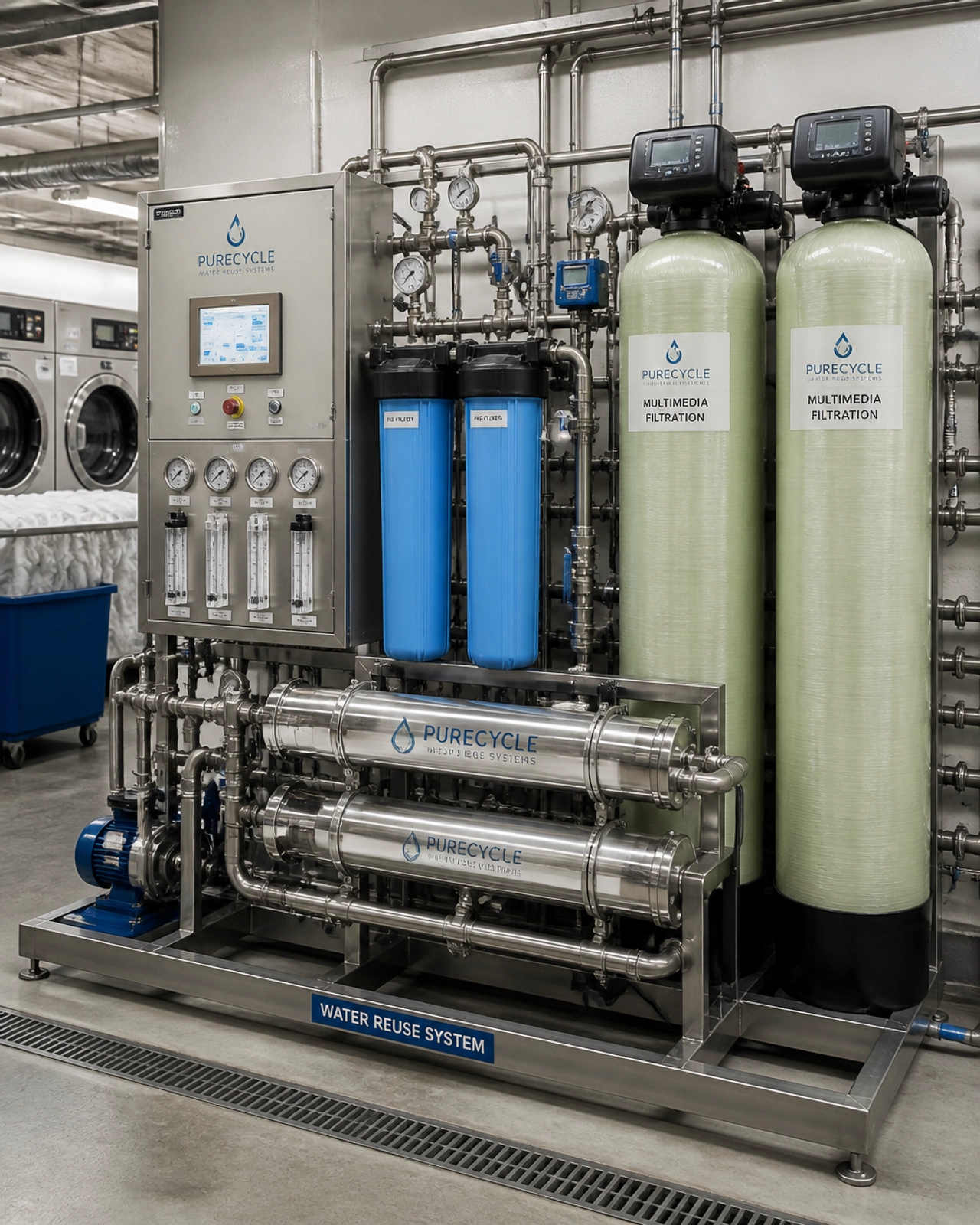
- Design Services: Optimizing your facility layout to integrate water reclamation skids seamlessly with your industrial washers.
- Expert Repair and Maintenance: Ensuring that your complex filtration systems are maintained for peak performance, preventing costly downtime.
- Warranty Security: We stand behind our work with a 3-year parts and labor warranty, providing the peace of mind necessary when investing in high-end industrial equipment.

Conclusion: The Cost of Inaction
In the world of industrial laundry, staying stagnant is often synonymous with falling behind. The "ROI calculation you haven't run yet" is likely the one that shows the cumulative cost of wasting water and energy over the next five to ten years. By adopting water reuse technology today, you are not merely cutting costs; you are future-proofing your facility against rising utility rates and environmental instability.
The path to operational excellence begins with a clear understanding of your current performance. We invite you to contact Wash IQ for a comprehensive audit and efficiency report. Let our experts show you exactly how much your facility could be saving through the intelligent integration of water reuse and industrial-grade equipment.