The Ultimate Guide to OPL Laundry Solutions: Everything You Need to Succeed
In today’s competitive market, the efficiency of on-premise laundry (OPL) operations has become a critical factor for success across various sectors, including hospitality, healthcare, and commercial service industries. An effectively managed OPL facility does more than just clean linens; it safeguards a business’s reputation, ensures the highest standards of hygiene, and significantly impacts the bottom line through operational cost control.
Transitioning to or optimizing an OPL solution requires a strategic approach that balances high-performance industrial laundry equipment with intelligent facility design and meticulous process management. This comprehensive guide provides the essential framework necessary to build and maintain a world-class laundry operation that delivers consistent, high-quality results.
The Foundation of OPL: Planning and Scalability
In the world of industrial facility management, foresight is the most valuable asset. The initial planning phase of an OPL operation dictates the long-term viability and profitability of the investment. It is essential to conduct a thorough analysis of current laundry volumes while simultaneously projecting future growth.
Assessing Capacity and Volume
The primary objective is to size your equipment based on peak daily poundage rather than average loads. Relying on average metrics often leads to bottlenecks during high-occupancy periods in hotels or increased patient turnover in healthcare settings. Selecting machines that can handle the maximum anticipated throughput ensures that your facility remains responsive and efficient under pressure.
Prioritizing Industrial-Grade Construction
In an OPL environment, equipment is subjected to rigorous, near-continuous use. Utilizing residential or light-commercial machines in these settings is a common error that leads to premature failure and exorbitant repair costs. Investing in industrial-grade laundry equipment is vital. These machines are engineered with heavy-duty components designed to withstand the stresses of high-capacity cycles, offering a significantly longer lifespan and a lower total cost of ownership (TCO).
Selecting High-Performance Industrial Equipment
The choice of equipment is the heart of any OPL solution. Modern advancements in laundry technology have introduced features that focus on maximizing extraction, reducing utility consumption, and providing precise control over every cycle.

Advanced Washer-Extractors
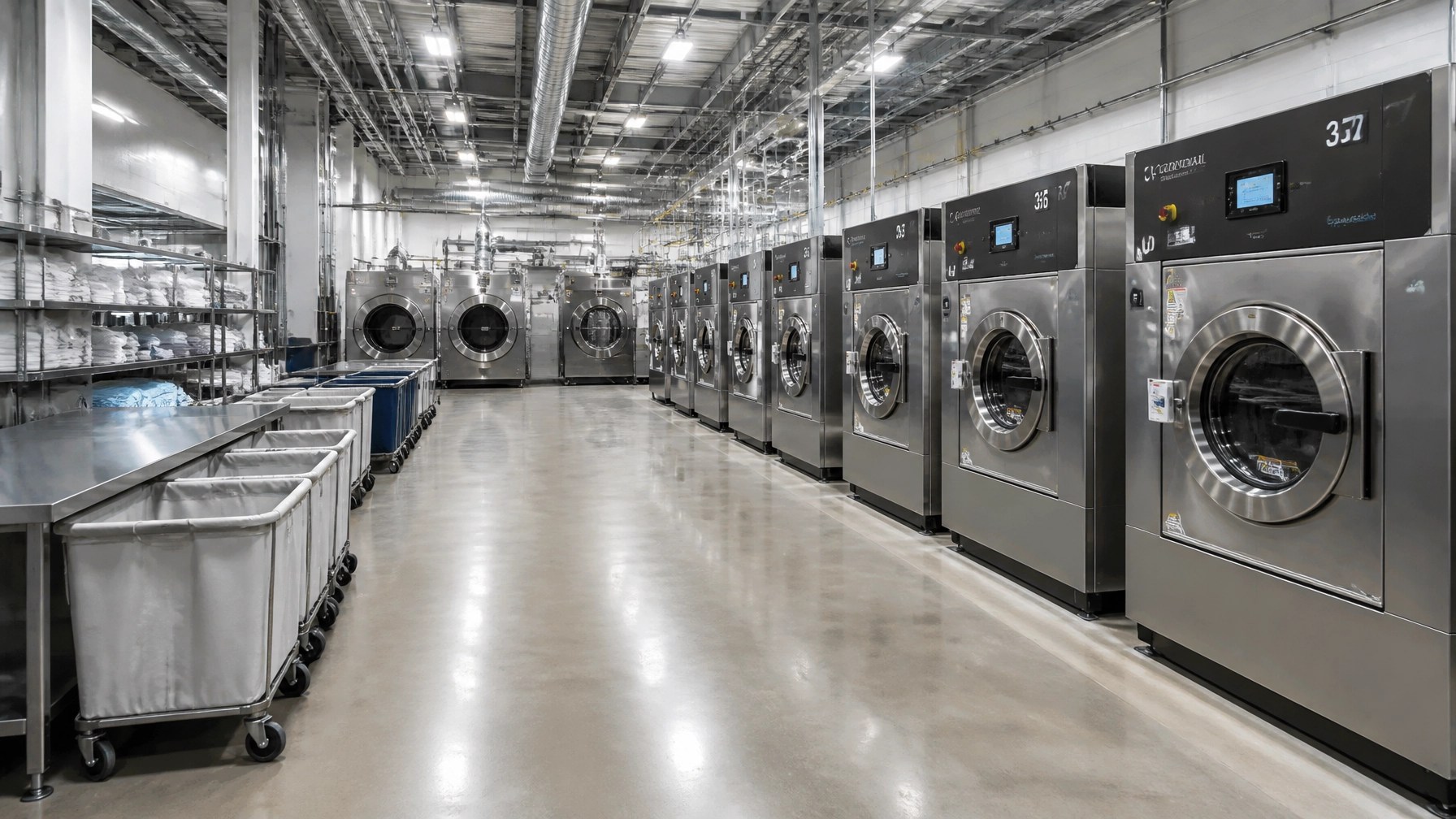
The efficiency of a laundry operation begins with the washer-extractor. At Wash IQ, we offer a range of solutions, including the HP Series Washers and the SI Series Industrial Softmount Washers, designed for high-performance extraction.
A crucial metric in washer selection is the G-force rating. High G-force extraction (often reaching up to 400G) is essential because it removes a greater volume of water during the final spin. This reduction in moisture content is vital, as it directly decreases the time and energy required in the drying phase: often by as much as 12%. Reducing dryer runtime not only lowers utility bills but also extends the life of your linens by minimizing their exposure to high heat and mechanical action.
Industrial Drying Solutions
Dryers are often the most energy-intensive component of an OPL facility. Selecting high-efficiency units, such as our DP Series Industrial Dryers or DE Series Dryers, is a strategic necessity.

Effective drying solutions must incorporate sophisticated moisture-sensing technology to prevent over-drying, which can damage fibers and increase energy costs. Furthermore, industrial dryers must be designed with high-airflow paths to ensure consistent drying throughout the entire load, regardless of its size or weight.
Optimized Facility Design and Workflow
Technical superiority in equipment must be matched by a logical and ergonomic facility layout. The design of your laundry space is important for minimizing labor costs and preventing cross-contamination, particularly in healthcare environments where hygiene is a primary concern.
Establishing a Logical Flow
A successful OPL layout follows a linear progression: Soiled Sorting → Washing → Drying → Finishing → Clean Storage. This "one-way" flow is a standard in professional laundry design as it prevents clean linens from coming into contact with soiled items. Wash IQ’s design services assist business owners in mapping out this workflow to maximize every square foot of the facility.
Ergonomics and Employee Productivity
Efficiency is not solely a product of machines; it is also a result of human performance. Machines should be installed at heights that facilitate easy loading and unloading, reducing the physical strain on operators. Adequate space must be allocated for carts, folding tables, and finishing equipment, such as an industrial flatwork ironer, to ensure that the transition between stages is seamless.

Operational Excellence: Chemicals and Programming
Even the most advanced equipment will underperform if the washing chemistry and programming are not optimized. In a professional OPL setting, a "one-size-fits-all" approach to chemicals is inadequate.
Precision Chemical Dosing
The correct application of detergents, destainers, and softeners is essential for achieving superior results while controlling costs. Over-dosing leads to residue buildup and potential skin irritation for guests or patients, while under-dosing results in poor stain removal and the need for costly rewashes.
Wash IQ provides chemical cost optimization services to help businesses fine-tune their dosing systems. By matching the chemical profile to your specific water hardness and soil types, you can achieve a cleaner product at a lower per-load cost.
Intelligent Control Systems
Modern industrial machines feature programmable controls that allow for the creation of customized cycles for different fabric types. Standardizing these programs ensures that every operator delivers consistent results. Utilizing automated systems to lock in these parameters prevents unauthorized changes, ensuring that the facility adheres to established hygiene and quality protocols at all times.

The Importance of Preventive Maintenance
To ensure the long-term reliability of an OPL operation, a proactive maintenance strategy is not optional: it is vital. Industrial laundry equipment is a significant investment, and its performance is directly linked to the regularity of its care.
Implementing a Structured PM Program
A preventive maintenance (PM) program focuses on identifying and resolving minor issues before they escalate into major, costly failures. This includes regular inspections of belts, bearings, seals, and drain valves. For facilities that operate 24/7, such as hospitals, even a few hours of unplanned downtime can have catastrophic consequences for linen availability.
Protecting Airflow and Energy Efficiency
One of the most critical daily tasks in an OPL facility is the cleaning of dryer lint traps. Accumulated lint restricts airflow, which significantly increases drying times and energy consumption. Furthermore, lint buildup is a primary cause of industrial fires. Rigorous adherence to cleaning schedules is essential for both operational efficiency and facility safety.
Conclusion: Partnering for Long-Term Success
In the world of OPL laundry solutions, success is defined by a commitment to quality, efficiency, and reliability. By selecting industrial-grade equipment, optimizing facility design, and adhering to strict maintenance and chemical protocols, businesses can transform their laundry operations into a source of competitive advantage.
Wash IQ stands as a premier partner in this journey. With over 50 years of industry expertise, we offer a comprehensive one-stop shop for everything from equipment sales and facility design to ongoing repair and maintenance. Our commitment to excellence, backed by a 3-year parts and labor warranty, ensures that your OPL operation is built to succeed today and for many years to come.