10 Questions to Ask Before Buying Commercial Washers and Dryers
In today’s competitive market, the selection of industrial laundry equipment is a critical decision that significantly impacts the operational efficiency and long-term profitability of your facility. Whether managing a high-volume hotel, a sterile hospital environment, or a large-scale banquet hall, the hardware you choose dictates your labor costs, utility consumption, and the quality of your finished linens.
Acquiring new commercial washers and dryers is a significant capital investment. To ensure your selection aligns with your facility's specific needs and operational goals, it is essential to conduct a thorough evaluation. At Wash IQ, we leverage over 50 years of industry expertise to help business owners navigate these complexities. Before finalizing any purchase, facility managers should address these ten vital questions to ensure high-performance results and operational excellence.
1. What is the True Daily Throughput Requirement?
Calculating capacity is the most crucial first step in selecting industrial equipment. Underestimating your needs leads to bottlenecks and equipment strain, while overestimating results in unnecessary capital expenditure and wasted utilities.
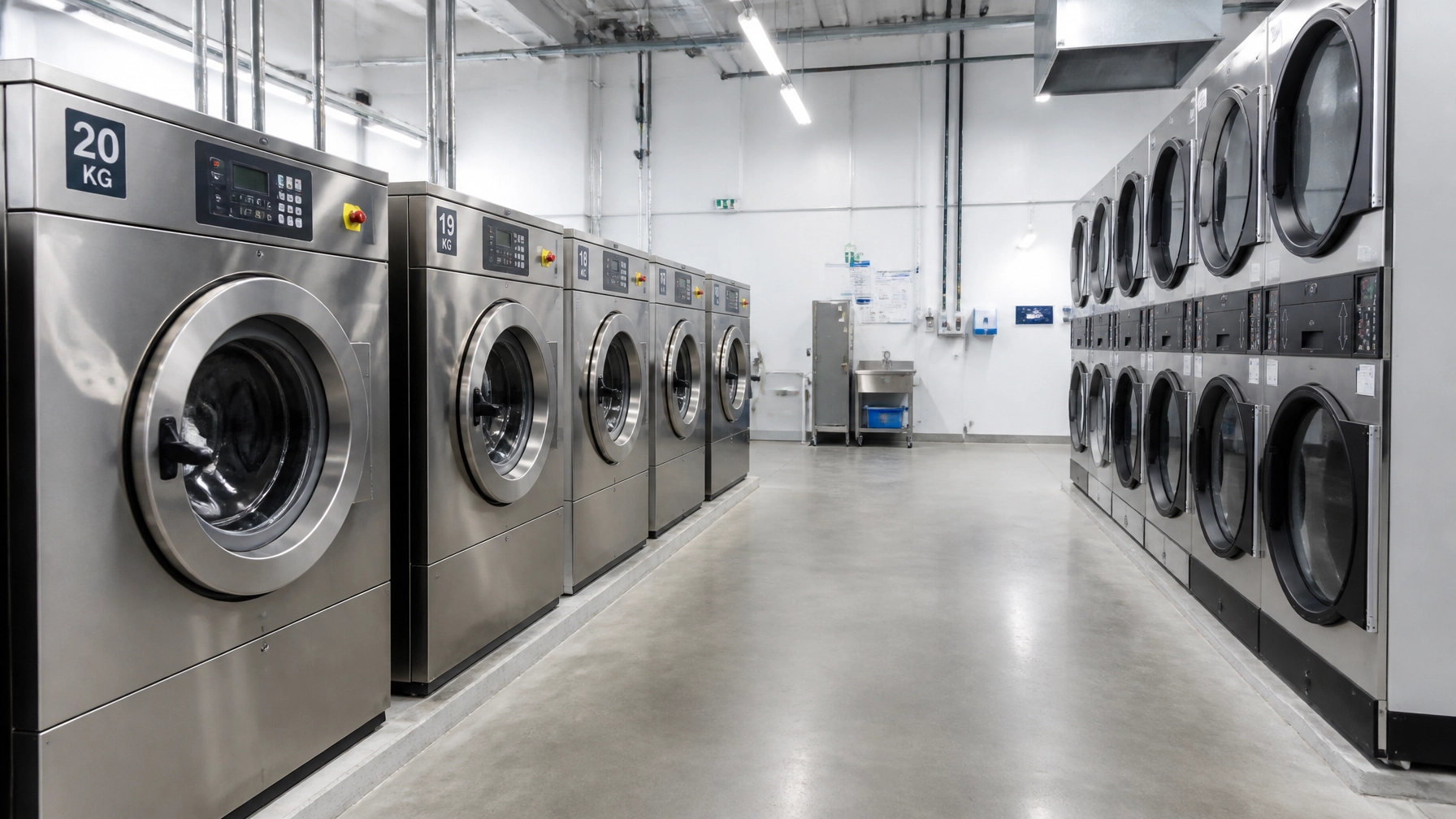
For many hospitality operations, a standard metric is roughly one pound of washer capacity per room, per day. However, high-volume facilities or those handling heavy specialty items must factor in peak loads and shift lengths. Ideally, your dryer capacity should be approximately 1.5 times the capacity of your washers to account for the longer drying cycles required for heavy textiles.
2. Does the Facility Support Hard-Mount or Soft-Mount Installations?
The structural integrity of your laundry room often dictates the type of machinery you can install.
- Hard-Mount Washers: These units must be bolted directly to a reinforced concrete foundation. They are typically more affordable but require a substantial floor structure to absorb the vibrations of high-speed extraction.
- Soft-Mount Washers: These machines feature internal suspension systems that absorb vibrations, allowing for installation on upper floors or over basements without specialized concrete pads.
Understanding your building’s limitations is essential to avoid costly structural failures or installation delays.

3. Are Existing Utilities Sufficient for Optimal Performance?
Industrial laundry equipment places significant demands on a building's infrastructure. You must verify that your electrical, gas, and water systems meet the specific requirements of the new equipment.
- Electrical: High-capacity dryers and large washers often require three-phase power.
- Gas vs. Electric: Gas-heated dryers generally offer higher efficiency and faster recovery times, but they require proper venting and gas lines.
- Drainage: Large-scale extraction can overwhelm standard drains, potentially causing flooding or hygiene issues.
Our design services at Wash IQ include a comprehensive assessment of your existing infrastructure to ensure seamless integration and compliance.
4. What is the Projected Impact on Chemical Consumption?
Chemical costs represent a recurring operational expense that can quickly spiral if not managed correctly. Modern industrial washers, such as those from B&C or Fagor, feature advanced chemical injection ports that precisely dose detergents and softeners based on the specific load.
It is vital to ask how the equipment integrates with automated chemical systems. Chemical cost optimization is not merely about using less product; it is about the precise application of chemicals to ensure hygiene while extending the lifespan of your linens.

5. Does the Equipment Offer Advanced Programmability?
In a world where textile types range from delicate banquet linens to heavy-duty industrial towels, a "one size fits all" wash cycle is insufficient. Advanced controllers allow managers to program specific cycles for soil levels, water temperatures, and rotation speeds.
Programmable controls empower your staff to achieve consistent results with minimal training, reducing the risk of human error and linen damage. Look for intuitive interfaces that provide clear diagnostic information to simplify troubleshooting.
6. How Efficient is the Extraction Speed?
Efficiency is the cornerstone of a profitable laundry operation. High extraction speeds (measured in G-Force) remove more water from the linens during the final spin cycle.
- Lower Moisture Retention: Leads to significantly shorter drying times.
- Utility Savings: Reduced dryer run times lower gas or electricity consumption.
- Higher Throughput: Faster cycles mean more loads processed per shift.
Machines with high G-Force ratings are essential for facilities looking to maximize their efficiency reports and minimize operational overhead.
7. What is the True Total Cost of Ownership (TCO)?
The purchase price of industrial equipment is only one component of its financial impact. A professional buyer must evaluate the Total Cost of Ownership over 10 to 15 years. This includes:
- Expected energy and water consumption.
- Anticipated maintenance costs.
- Availability and price of replacement parts.
- Resale value or longevity.
Investing in high-quality brands like Yamamoto or Milnor often yields a lower TCO due to their robust construction and long-term reliability compared to cheaper, lower-grade alternatives.

8. Is There Local Technical Support and Expert Repair?
Even the most reliable industrial equipment requires routine maintenance and occasional repairs. Before purchasing, confirm that your provider offers expert repair and maintenance services with technicians who are readily available in your region.
Downtime in a laundry facility is more than an inconvenience; it can bring an entire hotel or hospital operation to a standstill. Choosing a partner with over 50 years of experience ensures that when a breakdown occurs, it is handled with the urgency and technical skill required to restore operations quickly.
9. What is the Depth and Reliability of the Warranty?
A manufacturer’s warranty is a declarative statement of their confidence in the product. While many brands offer standard coverage, industrial-grade equipment should come with robust protection.
At Wash IQ, we provide a 3-year parts and labor warranty on our products, offering our clients peace of mind and financial predictability. Always read the fine print to understand what is included: and, more importantly, what is excluded: from your coverage.
10. How Will the Layout Impact Operational Workflow?
The physical placement of your washers, dryers, and finishing equipment, such as industrial flatwork ironers, determines the "flow" of your facility. A poor layout leads to unnecessary labor, cross-contamination risks, and safety hazards.
Integrating a new machine without considering the broader workflow can create bottlenecks. Professional design services can help optimize your facility layout, ensuring that linens move efficiently from the washer to the dryer and through to finishing and folding without backtracking or congestion.

Conclusion: Making an Informed Investment
The decision to upgrade or install new commercial laundry equipment is vital for any facility manager focused on excellence. By asking these ten questions, you move beyond the surface-level purchase price and focus on the factors that drive long-term success: efficiency, reliability, and operational cost reduction.
At Wash IQ, we are committed to being your one-stop shop for all industrial laundry needs. From initial design to chemical optimization and expert repair, our team provides the custom solutions required to keep your business running smoothly.
If you are ready to enhance your facility's performance, contact our specialists today to discuss a tailored equipment strategy that meets the unique demands of your operation.